

202nd regular session of the Government of the Republic of Slovenia
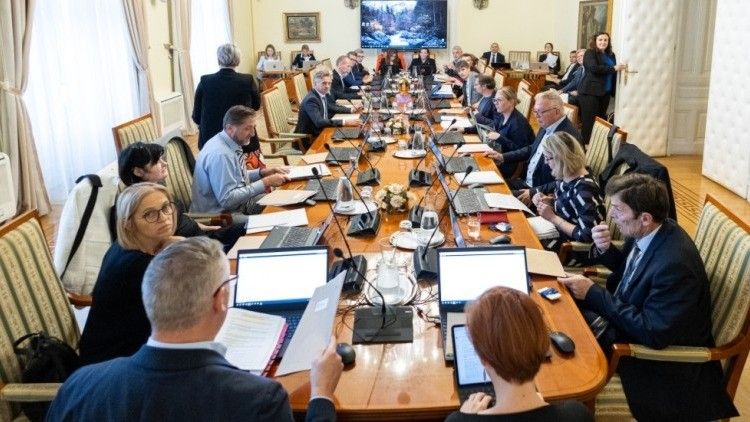
The Government today approved a reallocation of expenditure rights in this year’s state budget amounting to €133 million, with the aim of improving the general government balance. Together with savings in the health insurance fund and higher-than-forecast tax revenues, these reallocations will enable the Government to keep the general government deficit this year within the planned 2.9% of gross domestic product (GDP).
The largest share of adjustments will be made in the defence and infrastructure sectors, with funds being reallocated to the financial plans of the Ministry of Labour, Family, Social Affairs and Equal Opportunities and the Ministry of Education, both of which are recording shortfalls. A total of €75 million will thus be reallocated from the Ministry of Defence and the General Staff of the Slovenian Armed Forces to the Ministry of Education due to lower expenditure. The funds will be earmarked for the salaries of employees in primary schools and primary schools with adapted programmes.
The Ministry of Defence and the General Staff of the Slovenian Armed Forces will reduce expenditure mainly in the areas of equipment for the Slovenian Armed Forces, infrastructure and military modernisation. Other budget users have prepared proposals for reallocations of expenditure rights to the Ministry of Labour, Family, Social Affairs and Equal Opportunities for the payment of parental benefits. These reallocations amount to a total of €58 million, with the largest share, €30 million, contributed by the Slovenian Infrastructure Agency, which will reduce expenditure on the construction of state roads and investments in railway infrastructure. The remaining reallocations are smaller in scope.
Together with the planned reduction in expenditure by the Health Insurance Institute of Slovenia and higher-than-planned tax revenues, these reallocations will improve the state budget balance, which represents the main part of the general government balance, by €370 million. The general government deficit could therefore amount to the initially planned 2.9% of GDP this year.
The Government of the Republic of Slovenia took note of the reasons for extending temporary reintroduced controls at the internal borders with the Republic of Croatia and Hungary as of 22 June 2026 for a further six months, namely until and including 21 December 2026. The Government instructed the Ministry of Foreign and European Affairs to notify the Member States of the European Union, the European Parliament, the Council and the European Commission of the planned extension of temporary reintroduced controls.
The security situation in the immediate neighbourhood of the European Union and in the wider international environment remains unstable and continues to have a significant impact on the internal security of Member States. In addition to Russia’s continued aggression against Ukraine, EU Member States and candidate countries remain exposed to various destabilising activities, hybrid threats, disinformation campaigns and other security risks. Particular attention is also required in relation to Iran and broader regional developments in the Middle East.
Additional challenges are posed by cross-border criminal networks, irregular migration flows and the misuse of transport and logistics routes, all of which increase the complexity of monitoring and managing security risks. Slovenia’s national security authorities will continue to closely monitor potential risks, the security situation in the country and the wider region, and the effects of controls, with the aim of returning to an area without internal border controls as soon as conditions allow.
The Government has included a new project, Battery electricity storage systems – companies, in the current Development Programmes Plan 2026–2029. The purpose of the project is to encourage companies to invest in battery electricity storage systems, thereby contributing to more efficient energy use, the decarbonisation of the economy and greater use of renewable energy sources.
The project represents a continuation of measures supporting the green transition of the economy. Its aim is to support investments in battery electricity storage systems and thereby contribute to the diversification of energy sources, the electrification of production processes, reduced dependence on fossil fuels and lower greenhouse gas emissions.
The project will enable companies to co-finance investments in new technologies and other measures to achieve these objectives. The goal of the project is to implement a public call for the purchase of, or investment in, battery electricity storage systems by companies. Under the public call, the amount of the non-repayable financial incentive will be limited to a maximum of 45% of eligible investment costs, or a maximum of €225 per one kWh of electricity storage capacity.
Based on the available funds, it is estimated that between 300 and 500 companies will be eligible for incentives, depending on the size of individual investments. The estimated value of the project is €22,222,222.22. Ten million euros has been secured for the implementation of the project under the umbrella project Use of resources from the Climate Change Fund within the Climate Change Fund budget item, while the remaining share of the investment will be provided by the beneficiaries themselves. The project implementation and financing period is planned to run until 31 December 2026.