Ministry of Foreign and European Affairs
-
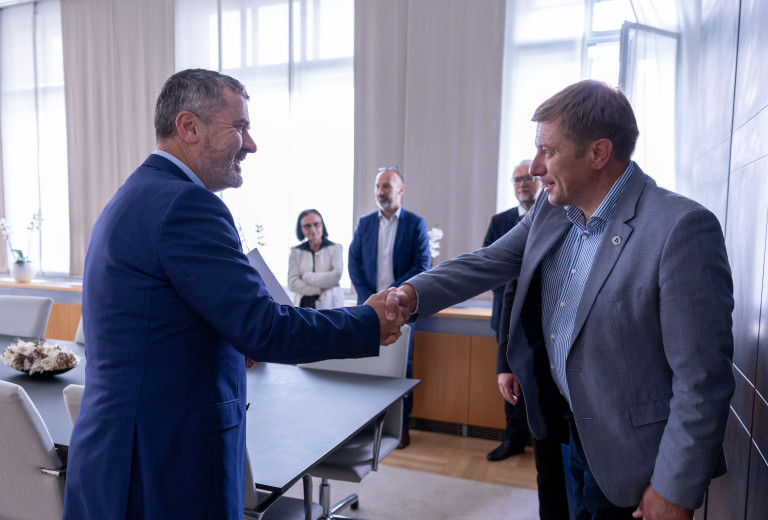
Minister of Foreign and European Affairs Tone Kajzer met with President of the Chamber of Craft and Small Business of Slovenia (OZS) Blaž Cvar and Danijel Lamperger, its CEO. The meeting focused on possible ways to provide further support to Slovenian craftsmen and entrepreneurs operating in foreign markets and facilitate their cooperation.
-
Tone Kajzer, Minister of Foreign and European Affairs, chaired the first meeting of the Strategic Council for Foreign Affairs in its new composition. Council members discussed the revision of Slovenia’s 2021 Foreign Policy Strategy. Against the backdrop of a changed geopolitical situation, the Strategy is an essential framework for shaping Slovenia’s future activities in international relations.
-
Minister Kajzer and German Foreign Minister Wadephul discuss strengthening the strategic partnership
On the eve of German Unity Day, Tone Kajzer, Slovenia’s Minister of Foreign and European Affairs, welcomed Dr Johann Wadephul, Germany’s Federal Minister for Foreign Affairs, to Ljubljana. This visit followed their meeting in Berlin in July and aimed to further strengthen the strategic partnership between Slovenia and Germany.
News
-
Slovenia’s efforts to promote the rights of older persons at UNHRC 63rd regular session
During the 63rd regular session of the UN Human Rights Council (HRC), Slovenia, as a Council member, actively participated in discussions on the gravest human rights violations worldwide and in negotiations leading to the adoption of numerous regional and thematic resolutions.”
-
Press release commemorating the victims of the Hamas terrorist attacks on Israel on 7 October 2023
Three years have passed since the terrorist attacks carried out by Hamas and other armed groups against Israel on 7 October 2023. Slovenia commemorates all those who were killed, injured or taken hostage that day, and stands in solidarity with their families and loved ones. The deaths of hostages, their suffering and the anguish of their families have left deep and lasting scars on Israeli society.
-
State Secretary Tamara Weingerl Požar attended political consultations in the Czech Republic
On 5 and 6 October, State Secretary Tamara Weingerl Požar visited Prague, where she held political consultations with Jiří Brodský, the Czech Republic’s Deputy Minister of Foreign Affairs. In addition to discussing bilateral relations, they covered current European and international issues.