

The “Our Rights” project - human rights education
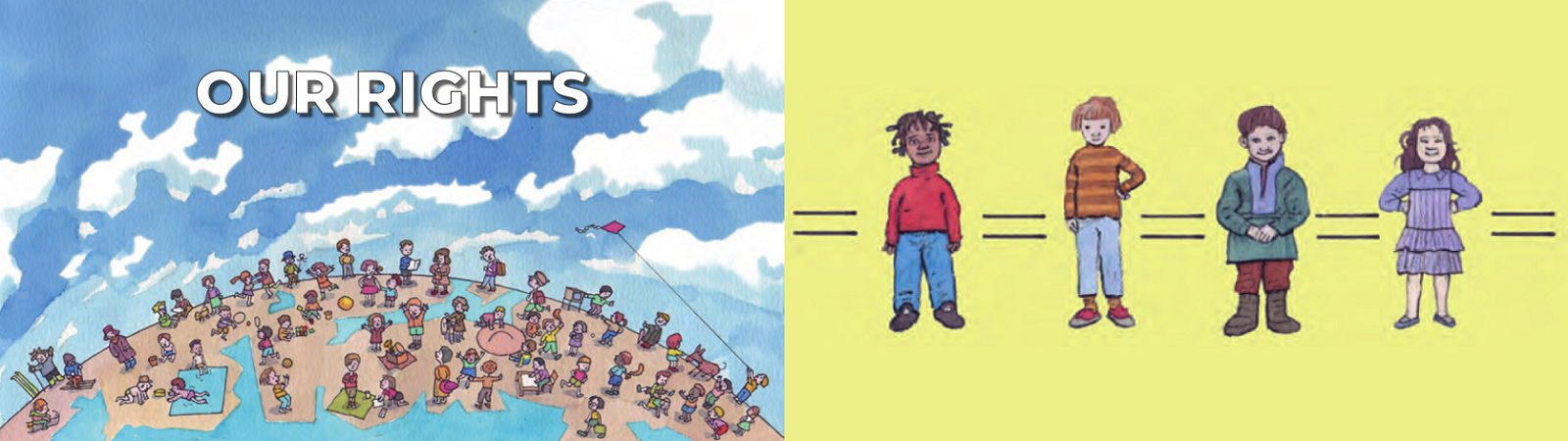
In a nutshell
Effective human rights education can help foster a culture of peace, tolerance and understanding of diversity in societies, including their religious, ethnic and cultural aspects and national minorities.
Since 2005, through the Our Rights project and teaching materials for children aged 10–12, Slovenia has provided education on children’s rights to more than 500,000 children in 27 countries in Europe, Asia, Latin America, Africa and the Middle East.
Joint and proactive engagement by states and non-governmental and international organisations in human rights education can help further advance universal values and respect for human rights.
Children everywhere must be given an opportunity to learn about human rights and be guaranteed respect for their own rights. Experience with the Our Rights project shows that different environments present both great opportunities and pressing needs in this regard. We believe that such projects and numerous other efforts by international organisations, NGOs and government institutions are extremely valuable. Involving children in processes that support their empowerment can boost their healthy development and promote long-term engagement in building peace and security.
Thabet Baker (age 14) from Gaza: “It’s good to learn about human rights, but sometimes very painful; I wish all children knew their rights and the rights of others so that they don’t harm or even kill each other when they grow up.”
Launch of the project in 2005
During its OSCE Chairmanship in 2005, Slovenia launched a pilot project on human rights education entitled Our Rights, based on the UN Convention on the Rights of the Child. Slovenian experts designed and led the pilot project, which involved a number of OSCE participating states, NGOs, individual experts, human rights ombudsman offices, local offices of international organisations and other stakeholders. There was great interest among OSCE participating states, so the Slovenian teaching tool was translated into 17 languages. The project reached 66,000 children in Albania, Azerbaijan, Belgium, Bulgaria, Bosnia and Herzegovina, Montenegro, Croatia, Ireland, Kosovo, Macedonia, Germany, the Russian Federation, Slovenia, Serbia, Turkey and Ukraine. It also involved children from minority groups, including Roma children in several countries in South-Eastern Europe. The Expert Assessment of the OSCE Pilot Project clearly showed that in all OSCE participating states it had helped raise awareness of the significance of teaching and learning about human and children’s rights.
The launch of the project coincided with the launch of the World Programme for Human Rights Education, which was adopted by the UN General Assembly on 10 December 2004, aimed at promoting a common understanding of fundamental principles and methodologies of human rights education, providing a concrete framework for action and strengthening partnerships and cooperation from the international level to the grass roots level.
Continuation of the project
In Kosovo, Ukraine, Bosnia and Herzegovina and North Ossetia-Alania (Russian Federation) the project continued independently between 2006 and 2008 and it is estimated that approximately 20,000 children participated. The project continued in Bosnia and Herzegovina, Kosovo and North Ossetia-Alania in September 2009, involving 52,000 children, namely the entire generation of 12-year-olds in Kosovo, children of all three main national communities in Bosnia and Herzegovina, and the entire generation of 11- and 12-year-old pupils in North Ossetia–Alania.
In 2010, the project was extended in North Ossetia-Alania, with an additional 15,000 children taking part and the project continued for several years. In autumn 2010, 30 children from Gaza undergoing medical rehabilitation at the Soča University Rehabilitation Institute in Slovenia participated in the project on a trial basis. In Kosovo, the Ministry of Education certified the project as a regular part of the school curriculum in 2010.
Since 2012, the project has been implemented primarily in the context of international development cooperation projects funded by the Ministry of Foreign and European Affairs of the Republic of Slovenia.
In 2012, it was carried out in Bosnia and Herzegovina, Macedonia, Kosovo, Moldova and in three republics of the Russian Federation (North Ossetia-Alania, Chechnya and Ingushetia), where it continued in 2013 and 2014, as well as in Serbia.
In 2014 and 2015, the project was implemented in Jordan, and in 2015 and 2016 in Morocco and Egypt.
In 2014, the project was presented in Brazil as part of the project Future at Stake: For Human Rights, for Children, for the Future, jointly conceived by the EU Delegation and Brazil. In the same year, it was also presented in Argentina on the occasion of an away match of the Slovenian national football team. Also in 2014, in cooperation with UNIS (United Nations Information Service), Our Rights flashcards in German intended for use in Austrian schools were presented in Vienna at a teacher training seminar.
In 2015, in Georgia, the Visegrad Group, with Slovakia at the forefront and in collaboration with local partners, organised a similar project based on the Our Rights materials translated into Georgian. In Gaza, the teaching material has been used since 2015 as part of the Psychosocial Programme implemented by ITF.
In cooperation with the non-governmental organisation BBA in India, which was founded by the 2014 Nobel laureate Kailash Satyarthi, Our Rights was implemented as a pilot project for 1000 children in New Delhi in the summer of 2016. In August 2016, it was presented to a group of children from Ukraine (more specifically, from Donbass and Luhansk) participating in a rehabilitation programme in Debeli Rtič in Slovenia in the framework of development assistance programmes implemented by ITF.
Between 2017 and 2019, the project was implemented again in Morocco, in 2016–2019 in Kosovo and in 2019 in Egypt and Slovenia. In 2020, the project implemented through the call for proposals for development cooperation (2018–2020) concluded for 1,056 children in Egypt and resumed through the call for proposals in 2021–2023. The project was re-launched in Albania in 2021 and 2022 for around 3,600 children per year, and has continued in 2023, 2024 and 2025. The teaching material was also translated into Japanese, where a pilot project was planned for 2021. The launch was postponed due to the COVID-19 pandemic, and the training of Japanese teachers started on Human Rights Day – 10 December 2022. In Kosovo, the project has continued; since 2022, it has involved 8,600 children per year from various regions and in total, the project has helped to empower over 110,000 children in around 700 schools, with almost 1,800 teachers trained since 2005. In 2024 and 2025, the participants also included minority children (Turks, Bosniaks, Gorani, Ashkali and Egyptians). In 2025, a special conference was organised in Pristina (link) to mark the 20th anniversary of the project, which is ongoing.
In 2024 and 2025, Our Rights has been implemented by civilian experts from the Ministry of Defence within civilian-military cooperation in Kosovo and Bosnia and Herzegovina, where the Slovenian Armed Forces participate in international missions.
In 2025, the project has received development cooperation funding for implementation in Albania and Kosovo, and has resumed in Ukraine (Izmail) and Moldova. The preparations for its implementation have begun in Ethiopia, where the materials have been translated into Amharic, and in North Macedonia. It has been proposed to start awareness raising on children’s rights in Slovenia, too, as the teaching materials are also available in Slovenian and Romani and could support integration and respect of universal human rights and children’s rights.
In 2026 the project continues in Albania, Bosnia and Herzegovina, Ethiopia, Kosovo, Moldova, North Macedonia and in Ukraine.
Children-Refugees worksheet
In spring 2016, on the basis of the experience gained during the Our Rights project, a worksheet entitled Children-Refugees was produced for children in the Slovenian education system as an additional tool for raising awareness of the universal rights of child refugees under the Convention on the Rights of the Child. By providing education on the rights of the child, schools make an important contribution to creating an atmosphere of understanding, acceptance and inclusion of children from abroad, as nobody should be left out.