

13th Regular Session of the Government of the Republic of Slovenia
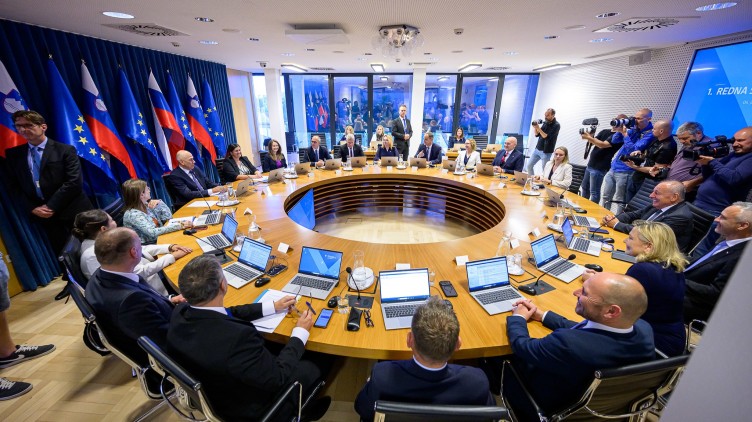
The Government began considering the budget documents for 2027 and 2028 and took note of the economic growth forecast for the next two years. It will adopt a final decision on the budget documents at a forthcoming session.
It took note of the monthly report on payments made from the state budget under the European cohesion policy programme 2021–2027, broken down by direct budget user. In March, Slovenia was still in 25th place for EU funding disbursements. It now ranks 19th. It has climbed six places in just a few months.
The Government withdrew as a co-founder of the Public Institute for the Development of Contemporary Dance, which it co-founded with the City Municipality of Celje and the City Municipality of Nova Gorica. A detailed review of the documentation showed that the founding documents could not be implemented in a way that would ensure the lawful, transparent and financially sustainable operation of the newly established public institute. The review identified several legal and implementation shortcomings, including inadequate financial planning, failure to comply with the prescribed co-financing procedures and unresolved issues concerning the institute's organisation and management. The relevant specialist services at the Ministry of Culture had already raised these concerns before the founding documents were signed. The decision to withdraw does not, however, mean that support for contemporary dance will be reduced. Through the Ministry of Culture, the Republic of Slovenia will continue to provide stable support to contemporary dance artists and producers through public calls for funding and other funding mechanisms. Investment in creativity, artistic production and access to high-quality programmes is the most effective way to secure the sector's long-term development. This must be accompanied by legally sound and financially sustainable institutional arrangements.
The Government appointed Erna Flogie Dolinar as Acting Director-General of the Surveying and Mapping Authority of the Republic of Slovenia, a body within the Ministry of the Environment and Spatial Planning. She has extensive experience in surveying, spatial planning and public administration. Her previous roles at the Surveying and Mapping Authority include heading the Knowledge Centre and serving as Deputy Director-General, coordinating the work of 42 organisational units with more than 470 employees. She has been involved in the digitalisation of spatial information, the establishment of the SLO4D system, the integration of spatial data and the implementation of European cohesion policy. Prior to this, she spent several years working in property mass valuation, cartography and topography. She holds a master's degree in urban and spatial sciences and a university degree in surveying.
The proposed Consumer Credit Act strengthens protection for consumers taking out loans and updates the rules to reflect new forms of lending and the conclusion of agreements online. The new legislation aims to ensure responsible lending and a high level of protection for consumers' economic and legal interests. One of the main changes is stronger protection when entering into credit agreements online. The new rules will also cover new financial products, including 'buy now, pay later' schemes. Furthermore, pre-ticked boxes will be prohibited when concluding agreements. Consumers will also have to be informed if an offer has been personalised for them on the basis of automated data processing. The draft act provides for clearer, more accessible information before a credit agreement is concluded. As a rule, consumers will receive key information at least one day before entering into an agreement, giving them time to make a more considered borrowing decision. Further measures will help prevent over-indebtedness and support consumers who are struggling to meet their financial commitments. These include a new public debt advice service, a ban on the unsolicited sale of credit and restructuring measures for borrowers who fall behind with payments.
The Government approved the proposed Act Amending the Consumer Protection Act to improve protection in relation to online purchases, green claims and repairs. The amendments strengthen consumer protection, particularly in online shopping, environmental claims and product repairs, and transpose three European directives into Slovenian law. The proposed act sets stricter rules for environmental claims, often referred to as green claims. It also encourages repairs and longer product lifespans. For certain categories of goods designed to be repairable, consumers will be entitled to require the manufacturer to carry out a repair. The new rules will also make spare parts more readily available at reasonable prices, and manufacturers will have to publish indicative prices for the most common or typical repairs. Consumers will be better informed and protected when deciding what to buy, while businesses will benefit from clearer rules and a level playing field. For agreements concluded online, a 'withdrawal button' will make it easier for consumers to withdraw from an agreement. Protection will also be strengthened against 'dark patterns', where the design of an online interface misleads consumers or steers them towards choices that are less favourable to them. Certain unfair commercial practices will be banned, including misleading environmental claims and false statements about product durability and repairability. Before making a purchase, consumers will also receive more information about product durability, repair options, spare parts, software updates and the legal guarantee of conformity.
The Government of the Republic of Slovenia approved proposals to amend the Higher Education Act and the Scientific Research and Innovation Activity Act. The proposed amendments adjust the pace of funding increases for higher education, science and innovation. The proposed amendment to the Higher Education Act temporarily adjusts the rate at which funding for study activities will increase in 2027 and 2028. The proposal brings higher education funding into line with the constitutional fiscal rule and European economic governance rules, while maintaining steady, predictable growth in public funding for higher education. The proposed amendment strikes a balance between two key national objectives: ensuring high-quality higher education that supports development and managing public finances responsibly. It therefore does not reduce funding, but slows its growth slightly over a two-year transition period. Funding for other statutory purposes relating to higher education remains unchanged. The amendment also continues to provide funds to cover the increased labour costs arising from new pay agreements and amendments to collective agreements in the public sector. The proposed amendment to the Scientific Research and Innovation Activity Act temporarily adjusts the pace of increases in public funding for scientific research and innovation activities in 2027 and 2028. The annual increase in the share of GDP during this period is set at a minimum of 0.0533 percentage points instead of the current 0.08 percentage points. The proposed amendment does not entail a reduction in funding, but rather a temporary slowdown in the growth of funding during the period of adjustment to the state of public finances. Funding will continue to increase in nominal terms in 2027 and 2028, thereby maintaining the stability and predictability of funding for the scientific research and innovation system. The purpose of the amendment is to align the legally prescribed pace of funding increases with the state's actual budgetary capacity, whilst the fundamental objectives of the system remain unchanged. The amendment also stipulates that a minimum of EUR 423.38 million shall be allocated to fund scientific research and innovation activities in 2026. Funding is provided within the framework of the financial plan of the ministry responsible for science and innovation, thereby ensuring a clear and predictable basis for the system's funding during the transitional period. The proposed arrangement therefore does not interfere with the fundamental development priorities for the funding of science and innovation, but rather temporarily adjusts the timetable for increasing funding. The objective remains to further increase public investment in scientific research and innovation and to gradually reach the statutory funding targets.
The proposed Act establishing a framework for measures related to emergencies in the internal market and its resilience establishes a framework for Slovenia to respond more effectively to any future crises that could affect the free movement of goods, services and persons, as well as the functioning of supply chains.The new legislation aims to increase the resilience of the internal market, improve preparedness for future crises and reduce the risk of disruptions in supply chains and the creation of undue obstacles to free movement. Experience from past crises, especially the COVID-19 pandemic, has shown that there is a need for a more coordinated and timely response by EU member states. The Act proposal therefore defines the competent authorities and sets out mechanisms for their cooperation and establishes an early warning and monitoring system for the supply chains of goods and services of critical importance. The Ministry of the Economy, Labour and Sport will act as the central liaison office and single point of contact, and will be responsible for coordinating and exchanging information between the competent authorities, the European Commission and other EU Member States. The proposed Act also regulates emergency procedures for so-called crisis-relevant goods. In the event of a state of emergency being declared, these procedures will enable priority treatment of conformity assessment procedures and, under certain conditions, faster placing of such goods on the market.
The amendment to the Decree on administrative operations alters the arrangements for office hours in administrative units and the associated business hours. The aim is to tailor administrative services to users' needs, as office hours on Tuesdays and Wednesdays will now uniformly begin at 8:00 and end at 18:30. Administrative units are one of the most important and direct points of contact between individuals and the state, as they enable individuals to exercise their rights, pursue their legal interests and fulfil their obligations in numerous administrative areas. To deal with many administrative matters, individuals still have to visit an administrative unit in person, while the current office hours largely overlap with the regular working hours of most employees. The aim of the change is to improve access to administrative services for users and to adapt the office hours of administrative units to users' actual needs. The Decree shall enter into force on the fifteenth day following its publication in the Official Gazette of the Republic of Slovenia.
The amendment to the Decree on working time in state administration authorities amends the existing arrangements for flexible working hours in administrative units as a result of changes to office hours and business hours set out in the Decree on administrative operations. The amended Decree will enable better access to administrative services for those users who, due to work and other commitments, would otherwise be unable to access these services, as administrative units have not previously had office hours in the afternoon, when users finish work. The flexible working hours of civil servants employed in administrative units will be adjusted on Tuesdays and Wednesdays to align with business hours and the office hours set out in the Decree on administrative operations. The flexible start time will be between 7:00 and 8:00, except on Tuesdays and Wednesdays, when the flexible start time will be between 7:30 and 8:30. The flexible finish time remains unchanged on Mondays and Fridays. On Tuesdays and Wednesdays, the flexible finish time will be between 18:30 and 19:00, and on Thursdays between 13:00 and 14:30. Flexible start and finish times in administrative units are no longer specified for Saturdays, as administrative units are closed on that day. The schedule for other working days and the working hours arrangements in the regional units of the authorities remain unchanged. The change does not increase the number of full-time working hours, but merely involves a different distribution of those hours. The amended Decree will enable better access to administrative services for those users who, due to work and other commitments, would otherwise be unable to access these services, as administrative units have not previously had office hours in the afternoon, when users finish work.
By amending the Decree on renewable energy sources in transport, the Government has reduced the mandatory share of renewable energy sources in transport for 2026. The amendment is intended to alleviate the pressure on retail fuel prices caused by the uncertain situation on the global oil markets. It also takes into account changes to the pricing model for certain petroleum products, which no longer includes the costs of adding bio-components. The Decree reduces the mandatory share of renewable energy sources (RES) in transport that fuel suppliers must achieve by 2026 from 13.8% to 10%. However, in accordance with the Act on the Promotion of the Use of Renewable Energy Sources, this share must not fall below 10% even in 2026. At the same time, the Decree allows for greater flexibility in meeting these obligations. Suppliers that fail to meet the prescribed share of renewables in 2026 will also be able to make up the shortfall in 2027 and 2028, in addition to using surpluses from 2023, 2024 and 2025. This arrangement will enable suppliers to manage costs more effectively and adapt to market conditions. The Decree shall enter into force on the day following its publication in the Official Gazette of the Republic of Slovenia.