

193rd regular session of the Government of the Republic of Slovenia
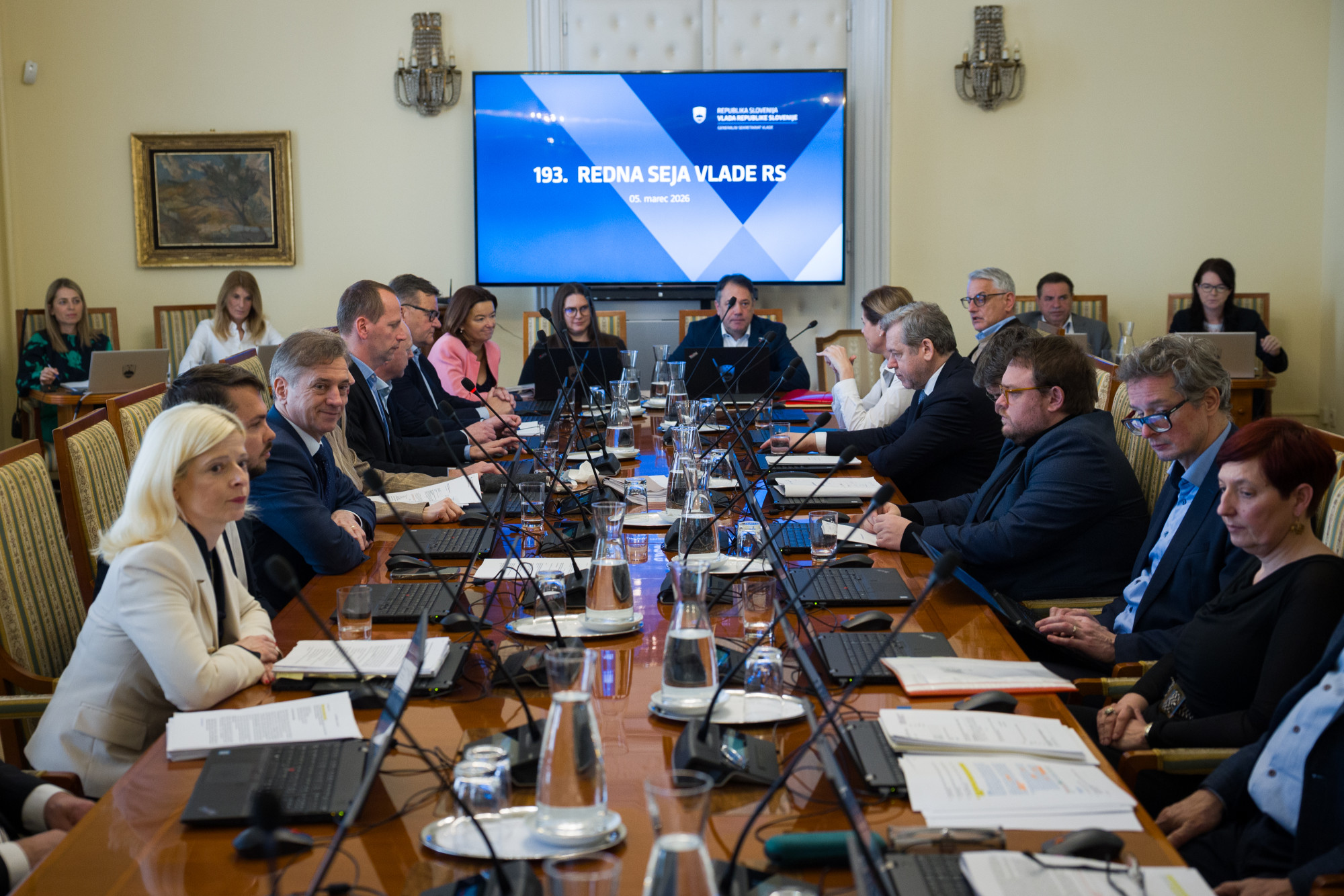
Author Bor Slana, STA
At today's session, the Government adopted the National Strategy for Artificial Intelligence until 2030 (NsUI 2030), with which Slovenia sets a comprehensive strategic framework for the development, introduction and responsible use of artificial intelligence in the economy, the public sector and broader society. The Strategy defines artificial intelligence as one of the key technologies for increasing the country's competitiveness, productivity, digital transformation and green transition. NsUI 2030 sets five strategic goals: the development of sovereign and trustworthy artificial intelligence, wider use of AI in the economy and public sector, strengthening the knowledge and innovation ecosystem, ensuring safe and responsible use, and strengthening Slovenia's international integration. The Government instructed the Ministry of Digital Transformation to prepare an action plan with precisely defined measures, a schedule and financial resources within nine months. By adopting the Strategy, Slovenia is strengthening digital sovereignty, promoting the development of domestic knowledge and technologies, and creating conditions for the development of advanced, ethical and safe artificial intelligence solutions for the benefit of people, the economy and the state.
With the Strategy for Regional Development of Slovenia until 2050, Slovenia is clearly opting for polycentric development, which strengthens all regional centres and reduces excessive centralisation in the Central Slovenia Region. The goal is to further strengthen Ljubljana as well as to create a country that is developing in a balanced way and has several strong centres. Only regions that are connected, resilient and competitive, and regions that are well-managed, can achieve the established objectives. The Strategy emphasises the economic transformation of regions with a focus on increasing productivity and competitiveness, developing human resources and facilitating access to services. The priority areas are: promoting economic transformation with a focus on increasing productivity and competitiveness as well as developing human resources; ensuring adequate accessibility in the regions to public services and infrastructure to achieve a high quality of life; focused support to border areas and areas with specific development challenges; strengthening the system of governance and implementation of development policies at the national and regional levels. The new regional development model is based on a territorial approach, which envisions targeted support to areas according to their specific needs and development characteristics, and emphasises the long-term orientation of economic development and quality of life in all regions, with access to jobs with higher added value as well as quality public and market services as close as possible to the place of residence. With this approach, the Strategy directly addresses people's everyday needs and reduces daily migration. In accordance with the Strategy for Regional Development of Slovenia, regions are no longer considered merely as implementers of local infrastructure projects, but as active sources of economic, innovation and social development of the country. The focus of regional policy is shifting towards knowledge, entrepreneurship, innovation and economic transformation. In the future, support for regions will be comprehensive, targeted and tailored to their development challenges. Measures and projects will be tailored to each region.
With the Slovenian Startup Strategy, which it adopted today, the Government is defining goals and measures for the development of the startup ecosystem in Slovenia until 2030. With the Strategy, Slovenia aims to create one of the best ecosystems for the creation and growth of innovative startups in Europe. The Strategy stems from the finding that increasing the competitiveness of the Slovenian economy requires a shift to activities with higher added value with systemic support for fast-growing innovative companies. The Strategy was created from the bottom up, in close cooperation with the ecosystem (incubators, startups, venture capital funds, etc.) and in close cooperation between various ministries. With the Strategy, Slovenia aims to accelerate the development of breakthrough innovations and bring them to global markets through innovative startup companies. The goals of the Strategy until 2030 are: doubling the number of startups per one million inhabitants, a tenfold increase in investments per capita, at least 25% average annual growth in the sector (in terms of employees, revenues and taxes paid), long-term preservation of the business and innovation functions of companies in Slovenia. The Strategy is based on five strategic initiatives: strengthening the support environment for startup and scaleup companies, developing the venture capital market, improving conditions for rewarding employees, attracting global high-tech talent and establishing a new form of business entity tailored to the needs of startup companies. To monitor the implementation of the Strategy, the Government will establish a steering committee as an interdepartmental working group that will coordinate the implementation of measures and monitor the achievement of the established objectives. The Slovenian Startup Strategy represents a framework for systematic and long-term support for the development of innovative companies and strengthening the competitiveness of the Slovenian economy.
The Government reviewed the Spring Forecast of Economic Trends 2026, which predicts that economic growth will strengthen with a gradual recovery of the export sector and strengthening private consumption. According to the central scenario, which does not foresee long-term increases in oil and gas prices, nor difficulties in their supply, GDP growth in Slovenia will strengthen this year (2.0%), which is very close to IMAD's autumn expectations, and it will be similar within the next two years. The export-oriented part of the economy will gradually recover, with improved prospects for industrial production in the most important trading partners. Investment activity will continue to grow, which will continue to be based mainly on public investments, and private consumption growth will also strengthen. This year, inflation (2.6% at the end of the year, 2.5% on average) will be similar to last year, and we continue to expect above-average growth in prices of services and food. In the following years, inflation will gradually decrease towards 2% in the absence of shocks. The realisation of the Spring Forecast is accompanied by major negative risks in the international environment, especially in connection with geopolitical conflicts in the Middle East, along with their escalation and possibly long duration. Another major risk that remains is the potential increase in trade barriers and the persistence of global trade uncertainty.
The Government decided to extend the possibility of claiming partial reimbursement of salary compensation by three months. On 5 December 2025, the Government of the Republic of Slovenia activated the so-called part-time work scheme for the period from 5 December 2025 to 5 March 2026, for activities in which temporary circumstances have occurred with a negative impact on the volume of employers' operations and thus on the temporary impossibility of providing a sufficient volume of work to workers. The Government decided to extend the period during which an employer can order an employee to work part-time and claim partial reimbursement of salary compensation by three months, which means that the period of implementation for this measure will last from 5 December 2025 to 5 June 2026. The decision applies to the same activities as before. Funds for salary compensation in the amount of €1,000,000.00 and funds for training, education and rewards in the amount of €50,000.00 will be provided by reallocation from the budget items of the active employment policy.