

International conference on the use of digital solutions in water management
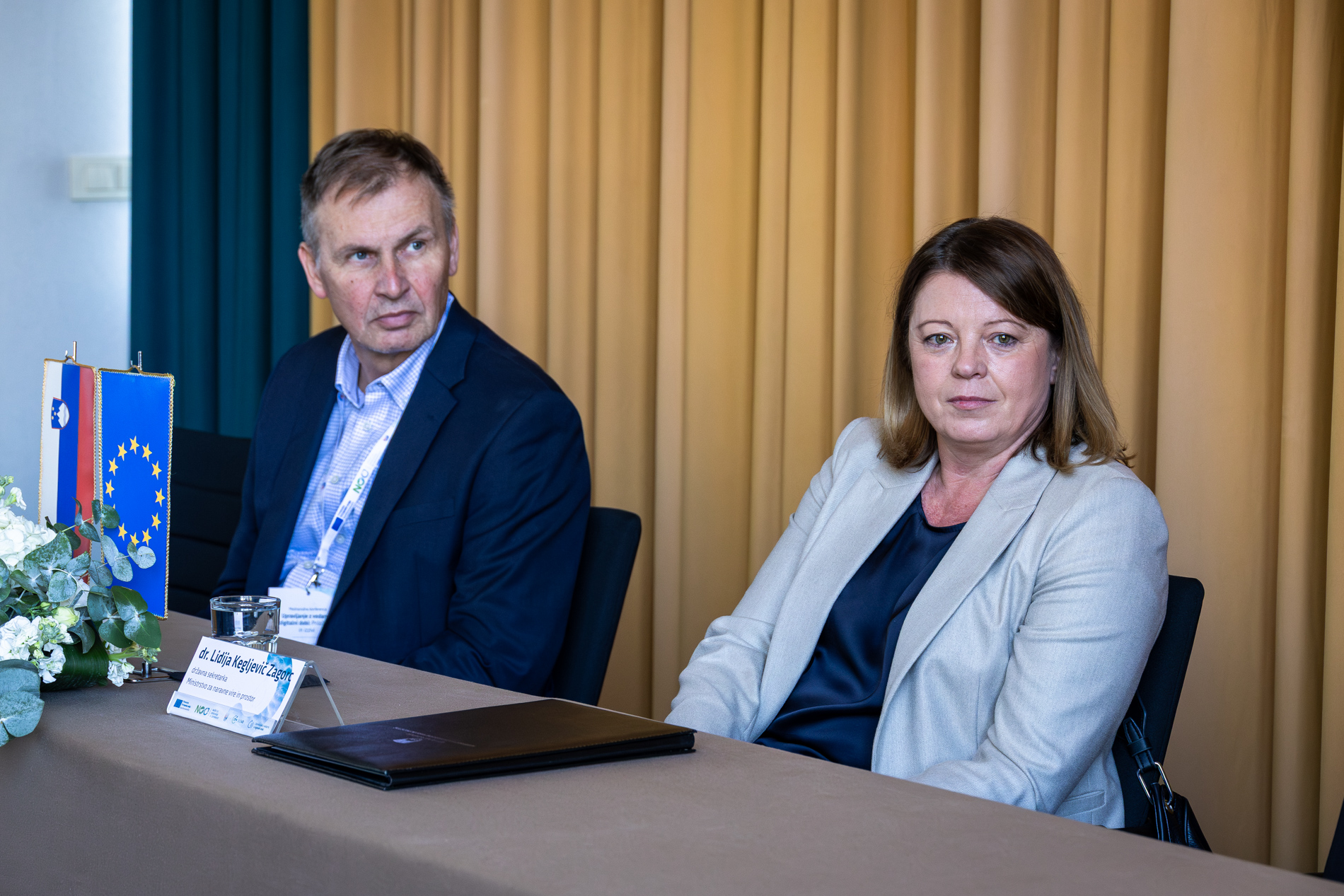
The opening address at the conference was given by the State Secretary at the Ministry of Natural Resources and Spatial Planning dr. Lidija Kegljevič Zagorc, who said: “The digital age enables us to connect knowledge, experience and data and direct them towards sustainable water management. After the catastrophic 2023 floods, the Ministry of Natural Resources and Spatial Planning has been working intensively to consolidate the water sector. In addition to all the ongoing activities pertaining to watercourses - we are deep into a five-year flood recovery programme, for which the government has allocated EUR 2.3 billion - we are also improving and strengthening the water management system. A key step towards achieving the set goals is the digitalisation of procedures, which enables better management, better control, greater transparency and greater efficiency.“
The Minister of Digital Transformation Ksenija Klampfer stressed in her opening address the importance of upgrading the digital infrastructure and said: “Water is the foundation of life and development, so the power of digital transformation must also be dedicated to its protection and sustainable management. Today, we can no longer afford to make decisions based solely on feeling or on averages; we need decisions based on data. This is why we must establish and upgrade the infrastructure that makes this possible – from sensors and cloud services to supercomputing and artificial intelligence. Only with data-driven solutions will we be able to effectively manage water resources and build a sustainable future.”
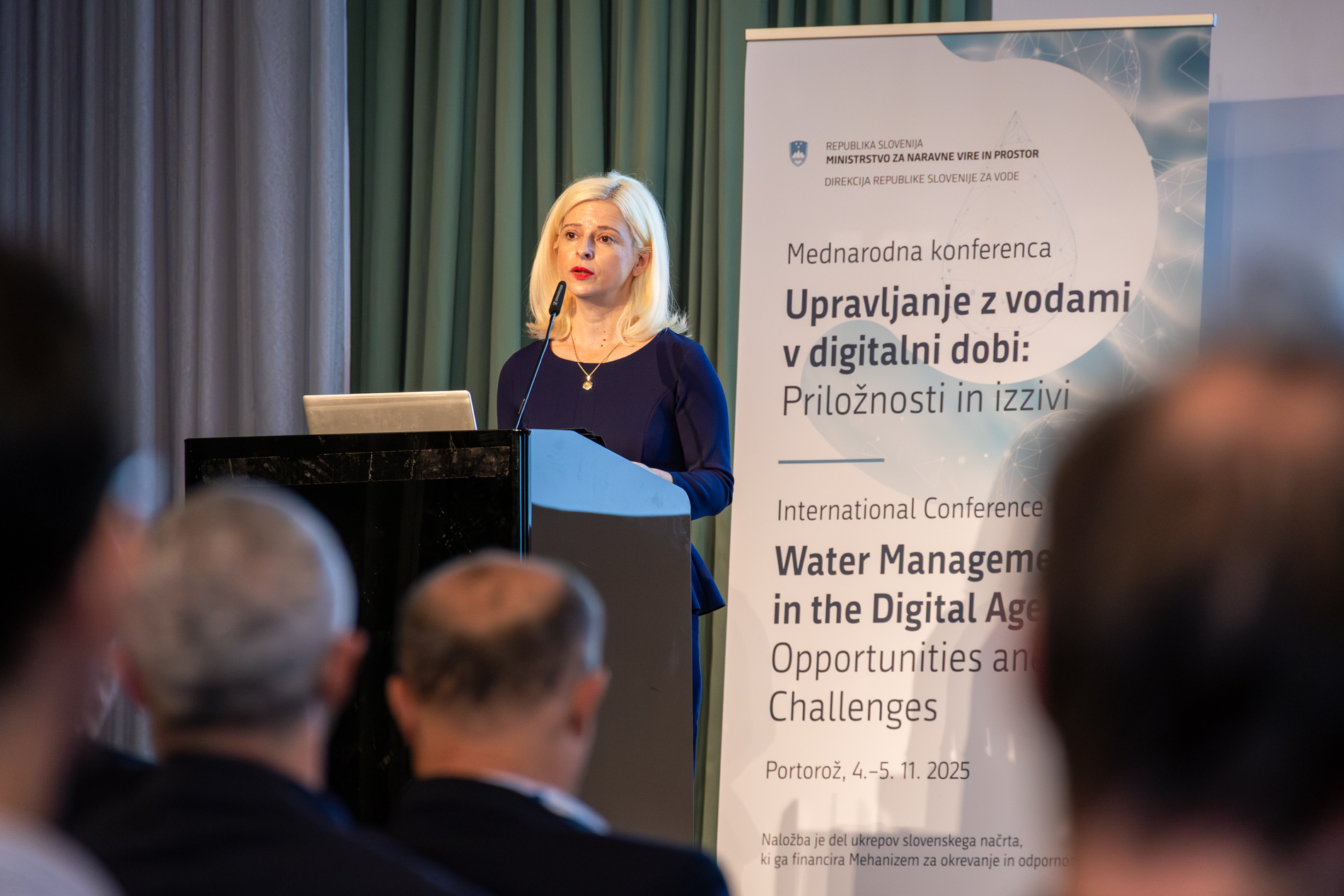
Opening address by The Minister of Digital Transformation Ksenija Klampfer
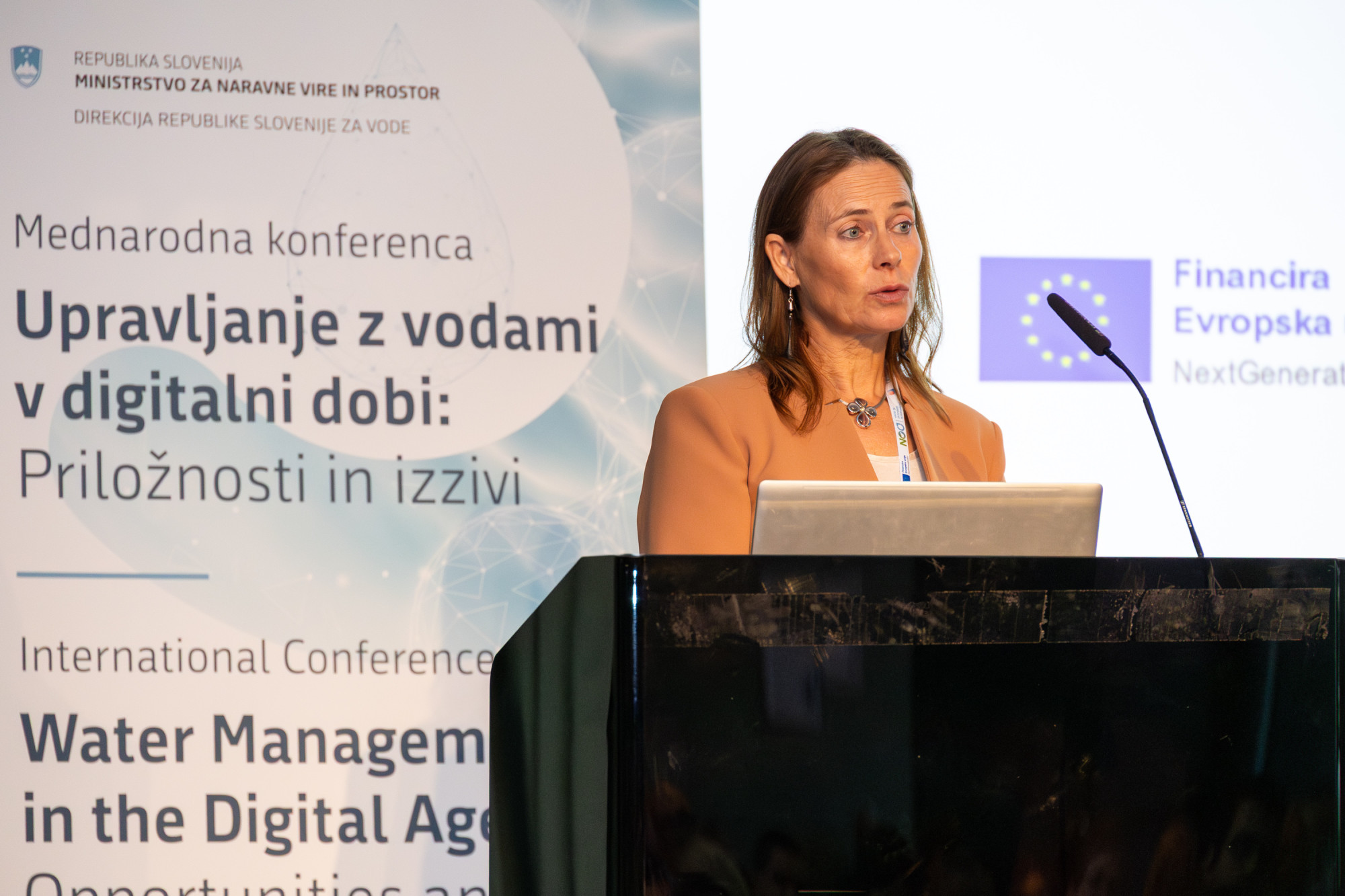
Use of digital solutions and presentation of good practices
At the two-day meeting, which took place as part of the Slovenian Location Framework (SLO4D) project, participants heard presentations of ongoing activities and project results, mainly in the field of water management.
Examples of good practice in cooperation between various institutions in cross-border river basins, and in establishing information systems for water management in Bosnia and Herzegovina and Germany, as well as practical examples of the use of artificial intelligence, emergency response experiences, collection and use of water infrastructure data, ways of improving data accessibility for users, research projects at universities in Ljubljana and Maribor, and development activities of the Institute for Water were presented. Activities for the planned upgrade of the eWaters portal and the Water Atlas GIS Viewer, where the DRSV already provides an extensive set of spatial data, were also presented, including plans to provide a better user experience and easier data management through upgrades of the web portal and the GIS Viewer.
Speakers at the international conference were experts from state institutions, representatives of international commissions for the Sava and the Danube river basin, representatives of the German and Austrian environment agencies, the Sava River Watershed Agency of Bosnia and Herzegovina, experts in water infrastructure management from the Water Authority Limburg in the Netherlands, professors from the University of Ljubljana and the University of Maribor, experts in spatial informatics, remote sensing and software solution developers from the private sector.
The developments in this area were summarised by Peter Kolenko, the head of the SLO4D project at the DRSV, who said: “The digital age is bringing fundamental changes in water management, as new technologies enable better understanding, monitoring and planning of water resources. The use of digital tools such as Internet of Things (IoT) sensors, remote sensing, artificial intelligence (AI) and big data enables more accurate collection and analysis of information regarding the quality, quantity and distribution of water. Such solutions contribute to more effective decision-making, early warning of droughts or floods, and optimisation of water consumption in agriculture, industry and households.”
Despite the great opportunities, digitalisation also brings challenges, with Peter Kolenko noting in particular the optimisation of procedures, “which will ensure better decision-making in water-related procedures and the indirectly related efficient use of space. A key part is a system for the improved distribution of data to various interest-based communities and good connectivity between different systems. We certainly must not forget about data security and privacy, which represents a growing challenge in a modern and open society.”
Green Slovenian Location Framework (SLO4D) project
The international conference “Water Management in the Digital Age: Opportunities and Challenges” is organised as part of the Green Slovenian Location Framework (SLO4D) project, which is implemented in partnership with the Surveying and Mapping Authority of the Republic of Slovenia, the Ministry of Natural Resources and Spatial Planning, the Ministry of the Environment, Climate and Energy, the Slovenian Environment Agency and the Slovenian Water Agency.
One of the most important goals of the Green Slovenian Location Framework (SLO4D) project is to link key spatial and environmental digital data infrastructure in such a way that essential processes and databases of spatial, environmental, water, nature and real estate systems are interconnected.
“Effective water management in the digital age requires a comprehensive approach that combines technological innovation, sustainable practices, empowerment of decision-makers, and broader community engagement. Only in this way will it be possible to utilise the full potential of digitalisation,” added Peter Kolenko.
As part of the SLO4D project, the DRSV implements activities to digitalise procedures in water management, thereby striving to:
- improve the quality and accessibility of water data,
- optimise implementation of procedures, and
- ensure the connectivity of water management processes with other spatial planning and construction processes.
As part of the project, the Geo Slovenia platform, which will ensure the connectivity of water management procedures with other spatial planning and construction procedures, has also been created under the auspices of the Surveying and Mapping Authority of the Republic of Slovenia. It is a sophisticated spatial information platform that provides interoperable connectivity, enables access to spatial data, services and applications, and ensures more efficient coordination of user needs. With the SLO4D project, the Surveying and Mapping Authority of the Republic of Slovenia has upgraded the country’s spatial data infrastructure so that it provides users with efficient services and high-quality official spatial data in ways that meet the high standards of a geoinformation-enabled society.
The SLO4D project is included in the Recovery and Resilience Plan and financed from European Union and Climate Fund resources and from the budget of the Republic of Slovenia.
More detailed information about the conference and the programme is available at the conference website on this link, while more about the Green Slovenian Location Framework (SLO4D) project can be found at the website of the project.
