GOV.SI

Slovenia Weekly: Resilience Project

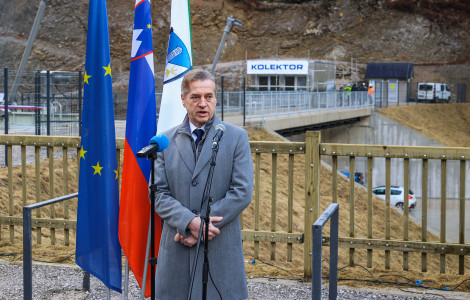
As part of the Government’s regional visit to the Gorenjska region, the Prime Minister, Robert Golob, reviewed the flood protection works in the Selška Valley river basin, a project designed to reduce flood risk in Železniki. The development in Železniki is of utmost importance not only for the Selška Valley, but also for Slovenia as a whole. “This project sets a clear direction for Slovenia — not only for this Government, but for all future governments — demonstrating that investment in resilience is the only form of investment that truly strengthens our security and enables us to say that we are living better lives,” the prime minister said. By delivering projects like this one, we safeguard precisely what matters most — our security. “That is the principal message I wish to convey, not only to the people of the Selška Valley, but to everyone. From this day forward, you can feel safe. Across Slovenia, we are building resilience projects so that we and our children may live in a safe country,” Prime Minister Golob concluded.

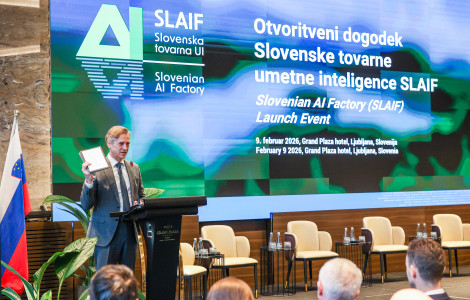
Slovenia is keeping pace in the field of artificial intelligence, as demonstrated by the launch of the Slovenian AI Factory (SLAIF) that will support the transfer of this knowledge into the economy. SLAIF will facilitate, among other things, the introduction of artificial intelligence across industry, the public sector, and scientific research. The Government is also considering providing access to citizens, thereby establishing a national generative artificial intelligence platform to be hosted within the Slovenian AI Factory.

  • P SVL Gorenjska 10022026 (Robert Golob is standing, with flags on the left and a bridge behind him.)

    Prime Minister Golob: We are building a resilience project so that we can live in a safe country

    10. 2. 2026

    As part of today’s regional visit of the Government of the Republic of Slovenia to the Gorenjska region, Prime Minister Robert Golob, together with the Minister of Natural Resources and Spatial Planning, Jože Novak, first visited the flood protection arrangements in the Selška Valley catchment area, aimed at reducing flood risk in Železniki.
  • 55088372644 de4bcebe6d h  FitMaxWzIwMDAsMjAwMCwiMzU0YjY3YWY1YSJd (U-shaped seating arrangement)

    191st regular session of the Government of the Republic of Slovenia

    10. 2. 2026

    At today's session, the Government took note of the status of the siting of the Kranj North motorway junction and of the expert assessment of the justifiability of reinstating the railway infrastructure to the Hrušica stop. It also adopted the Strategy for the resilience of critical entities and placed the tasks of the 114 call centre within the Secretariat-General of the Government.
  • 55086683716 bcce3d4708 o (Prime Minister Robert Golob standing at a podium)

    Prime Minister Golob attends the opening of the Slovenian AI Factory (SLAIF)

    9. 2. 2026

    Prime Minister Robert Golob attended the opening event of the Slovenian AI Factory (SLAIF), which will host a new supercomputer. For the first time, the supercomputer will also be available to industry. It represents a tool for accelerating innovation in the economy, increasing productivity and strengthening global competitiveness.
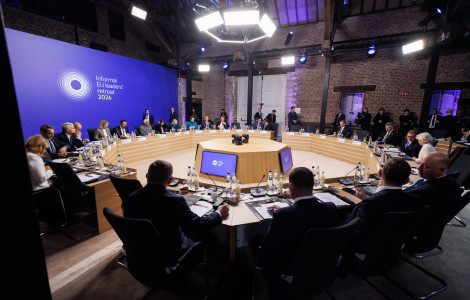
  • 55091786888 3324c93ac5 o (People sitting at a round table in a big hall)

    Prime Minister Dr Robert Golob: Europe needs to act more swiftly and decisively

    12. 2. 2026

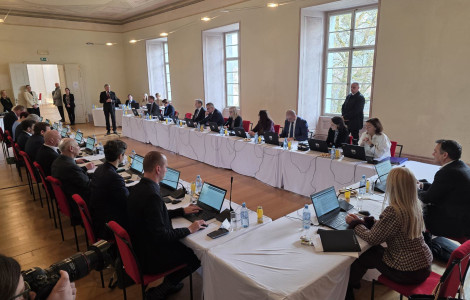
    Today, Prime Minister Dr Robert Golob attended an informal meeting of the members of the European Council at Alden Biesen Castle in Belgium.
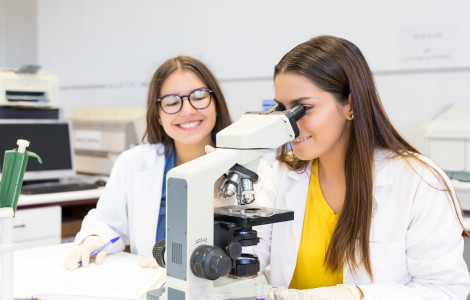
  • Mladi znanstvenici v laboratoriju (Two young scientists in lab coats working with a microscope in a laboratory.)

    International Day of Women and Girls in Science

    10. 2. 2026

    The United Nations General Assembly decided to proclaim 11 February as the International Day of Women and Girls in Science to raise awareness of the importance of the full and equal participation of women in all fields of science. The aim is also to promote the elimination of discrimination and the removal of legal, economic, social and cultural barriers that continue to hinder women’s access to careers in science.