

Slovenian New York church turns 110
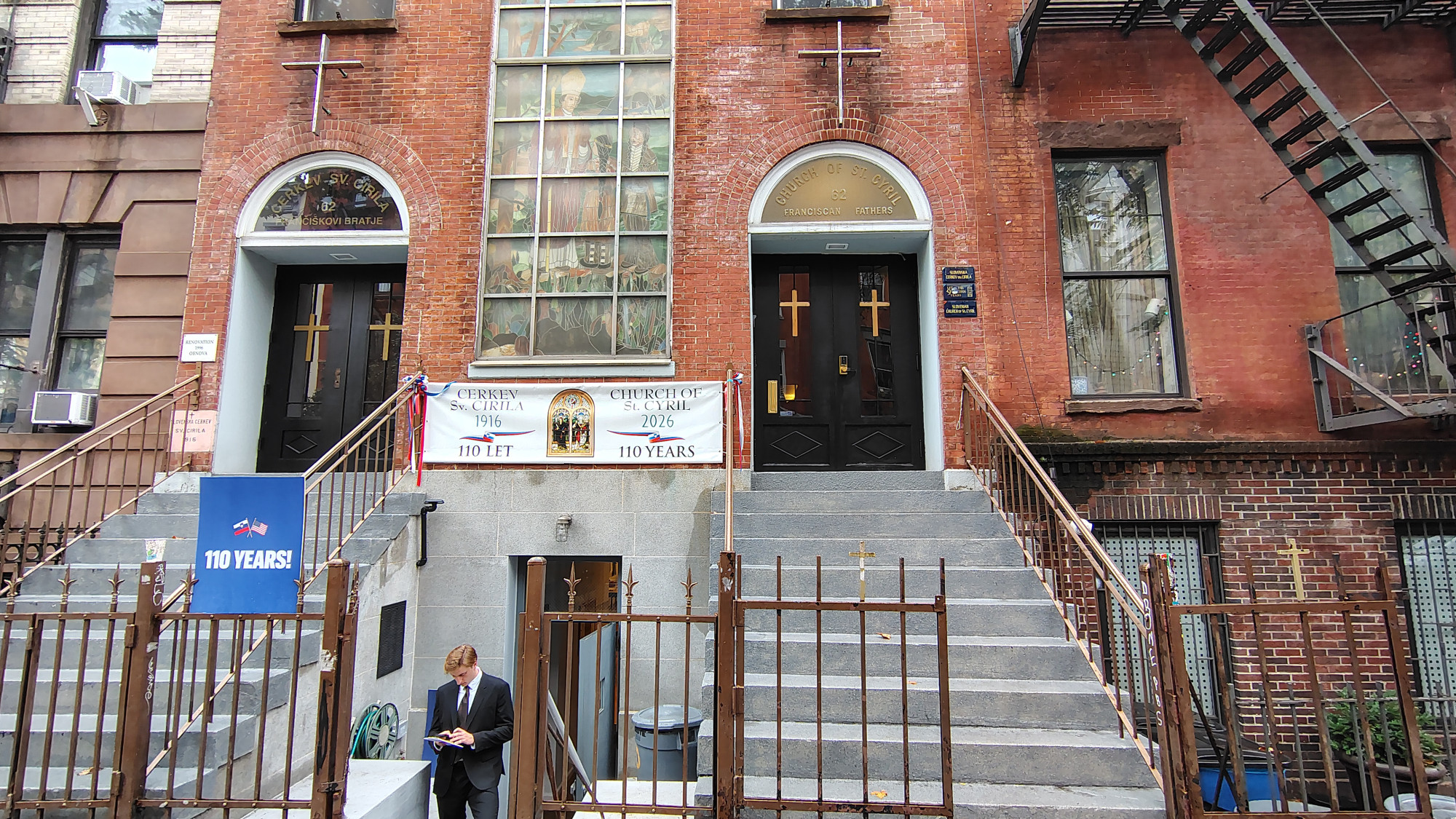
St Cyril's Church in New York's East Village | Author Robi Poredoš, STA
For generations of Slovenians arriving in America, the church has offered a place where they could speak their language, meet fellow Slovenians and maintain a connection with their homeland.
That role has not disappeared, but the anniversary celebrations highlighted how the church is finding a new lease of life as a community centre for a more diverse and younger Slovenian population in New York.
The church was founded in 1916, when several thousand Slovenian immigrants in New York were large enough in number to seek a church of their own after previously attending mostly German Catholic churches. From the beginning, it served both religious and cultural purposes, hosting not only masses but concerts, exhibitions, receptions and celebrations of Slovenian holidays.
That dual role has become particularly important as the original immigrant generation has disappeared and the community has changed.
More than a church
Father Martin Krizolog, who has led the parish since Slovenia's independence, remembers being told when he arrived that he would probably stay for two years before the church closed. Three decades later, he is still there.
The church's fortunes improved after Slovenia became independent in 1991, which Krizolog said gave Slovenian communities in the United States a new emotional connection to their homeland. Today he sees New York's enormous international appeal as another source of opportunity for the Slovenian community.
The building has also taken on a practical role that extends well beyond the parish. With neither the Slovenian bank LBS nor a general consulate still operating in New York, St Cyril's has become the main gathering place for the local Slovenian community, hosting religious and secular events as well as diplomatic functions.
For younger Slovenians, that may be the church's most important role. Ana Grošelj, who has organised events for young Slovenians in New York for several years, said the church provided a place where people can meet regardless of how regularly they attend Mass. She sees the prospect of losing it as a loss for the wider community, not simply for churchgoers.
The number of people attending church had declined over the decades, but community activity has recently begun drawing young people back. "The most important question is not only whether we will preserve the building," Krizolog said. "The question is whether we will preserve the community."
A wider American story
St Cyril's endurance is not typical of the long-term trajectory of older immigrant churches in the United States, where assimilation, ageing communities, fewer new immigrants and a shortage of priests have steadily weakened many of those institutions. In New York itself, St Cyril's is now among the relatively few ethnic churches of its kind still operating.
That makes the question of succession particularly pressing. Father Krizolog's future replacement is uncertain, raising the possibility that the parish could eventually come under the New York Archdiocese rather than remain under the Slovenian Franciscans. The concern is that a diocese with no particular connection to the Slovenian community may have little reason to maintain a church serving a relatively small ethnic congregation.
There has already been discussion of whether Slovenia or the Slovenian community could eventually acquire the building. Krizolog says the idea will remain a "current topic", although the Franciscans continue to run the parish for now. The obstacle is largely financial: a historic Manhattan church, housed in a brownstone in the East Village, would be very expensive to acquire.
What happened elsewhere
The experience of other Slovenian communities in the United States shows both how difficult the challenge is and what can be done.
In Bethlehem, Pennsylvania, Slovenian immigrants from Prekmurje built two churches more than a century ago: a Protestant church in 1910 and a Catholic church in 1914. Both originally served communities centred around the Bethlehem steel industry. But as the immigrants aged, new arrivals stopped coming and the steel plant closed, the communities struggled to maintain their churches.
The Slovenian Protestant community lost its historic St John's Windish Evangelical Lutheran Church, but the Catholic community's story has taken a different turn.
The Diocese of Allentown closed St Joseph's Church in 2008 along with dozens of other ethnic churches, citing declining numbers of parishioners, priests and financial resources. After a prolonged campaign, including an appeal to the Vatican, the Slovenian community was eventually able to buy the church in 2024 through a newly established non-profit.
Ljubljana Archbishop Stanislav Zore, like Father Krizolog a member of the Franciscan order, told the anniversary mass in New York that the future of the church was a difficult issue but that there was "no need to ring the alarm yet". But Father Krizolog noted that preserving the church would require "understanding and support from the Slovenian church and state".
Source: The Slovenia Times, STA