

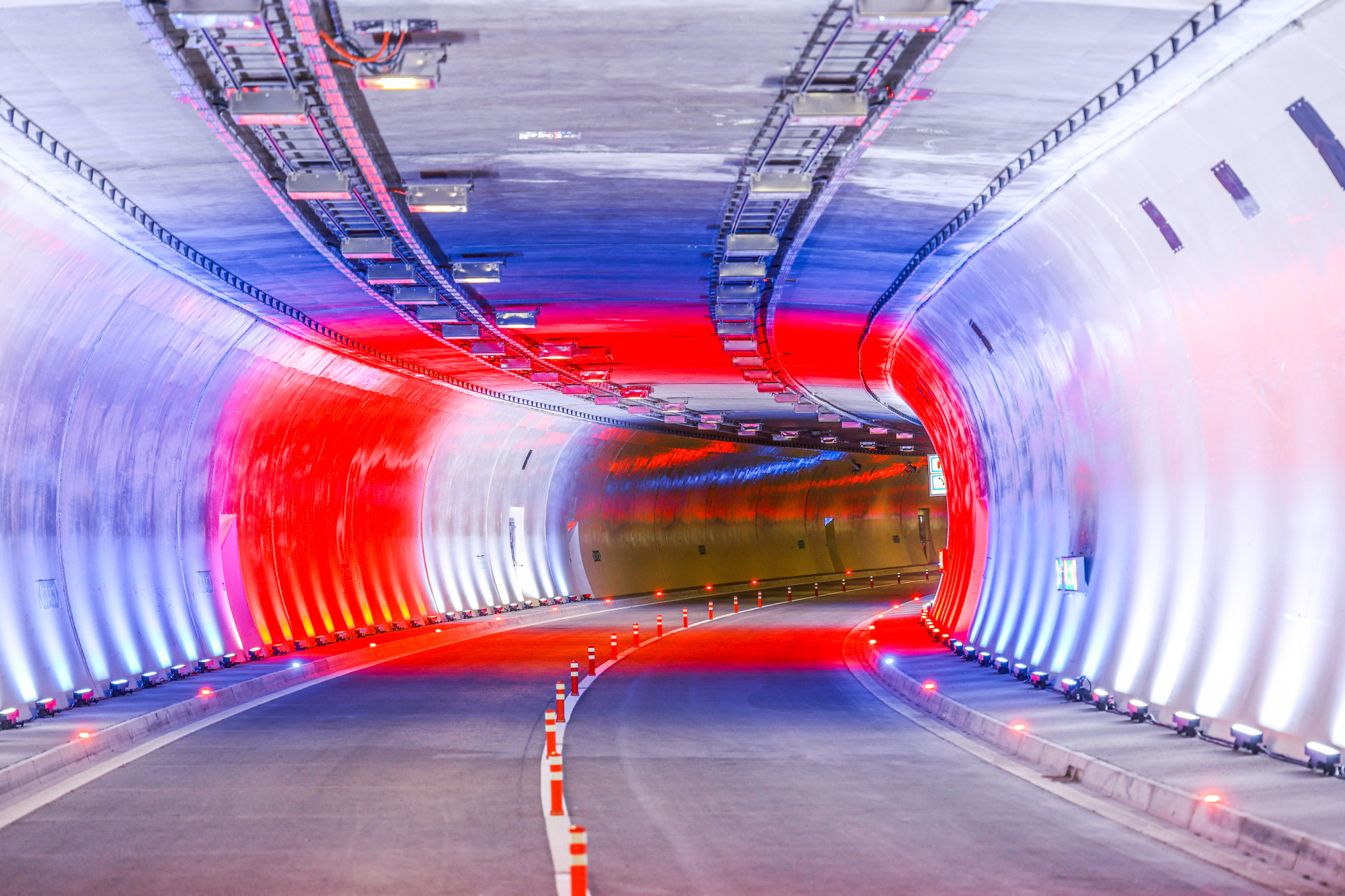
New tube opens in motorway tunnel linking Slovenia and Austria
Author Daniel Novakovič, STA
It will open to traffic on 20 March but as the old one closes for renovation it will take more time until traffic congestion in the area is alleviated.
The construction work on the Slovenian side of the border was done by Turkish contractor Cengiz, which started boring the tunnel in August 2020 and completed the work in June 2025.
Following several annexes, the value of contract with Cengiz rose from the initial €98.6 million to almost €115 million without tax. Taking into account the cost of technical installations and consulting and engineering services, the total value of the investment exceeded €147 million without VAT.
In total, the new, eastern tube measures eight kilometres in length. The Slovenian side is 3.5 kilometres long, and the construction there was more challenging due to geological characteristics.
Traffic congestion not yet alleviated
The busy tunnel is now a twin-tube structure, but it will take a few additional years until this major upgrade starts alleviating traffic congestion on both sides of the border, as the western tube is now set to undergo reconstruction.
The upgrade of the 35-year-old tube is expected to be completed by the end of 2028, and both tubes should have one-way traffic running on both lanes at the beginning of 2029.
The work on the Slovenian side of the border is valued at €82.5 million without VAT. The contractors on the project are Kolektor CPG, Gorenjska Gradbena Družba and Kolektor Koling.
Longest road tunnel in Slovenia
Linking the A2 motorway in Slovenia and the A11 in Austria under the Karavanke mountain range, the tunnel was inaugurated in 1991 as the longest road tunnel in Slovenia and the 9th longest in the Alps.
Traffic through the tunnel has increased significantly in recent decades. In 2005, an average 6,200 vehicles crossed it per day, while in 2023 the figure rose to 13,500, of which 1,700 were freight vehicles.
The tunnel is a major bottleneck in peak seasons, particularly in the summer as holidaymakers from across Europe cross it on their way to the Adriatic coast and back home again.
The tunnel is often alternately open to one-way traffic due to safety concerns, creating gridlock on both sides of the border. To alleviate congestion and upgrade safety standards Slovenia and Austria decided to build a second tube.
They reached an agreement on that in 2012, and their respective motorway companies invited bidders to tender in 2017. The following year, the work started on the Austrian side of the border, but it was not until 2020 when the project got under way in Slovenia, too, due to delays in contractor selection.
New tube hailed as major achievement
The inauguration of the new tube does not only mark the completion of a major infrastructural project but also a valuable investment in people's safety, economic competitiveness and the long-term stability of cross-border connections, Infrastructure Minister Alenka Bratušek told the inauguration ceremony on 18 March.
This is now Slovenia's most modern road tunnel, and it is also part of a major European transport corridor, she said, adding that this year was the year of tunnels as Slovenia recently also inaugurated a new railway line between Divača and the port city of Koper, which features a number of tunnels.
The total length of the tunnels completed, which include the new tube, the Koper-Divača tunnels and the tunnels built on the northern section of an emerging north-south expressway, is some 32 kilometres, according to the minister.
Andrej Ribič, CEO of the national motorway company DARS, also described the new tube as a major achievement promoting traffic safety, mobility and international cooperation.
He mentioned a few pieces of interesting trivia: during the construction on the Slovenian side of the border, they excavated enough material to fill 171 Olympic-size swimming pools, used enough concrete to fill 78 such pools, and used as much steel as there are iron parts making up the Eiffel Tower.
Source: STA