

Prime Minister at the European Council: Cohesion and the Common Agricultural Policy are essential for Europe
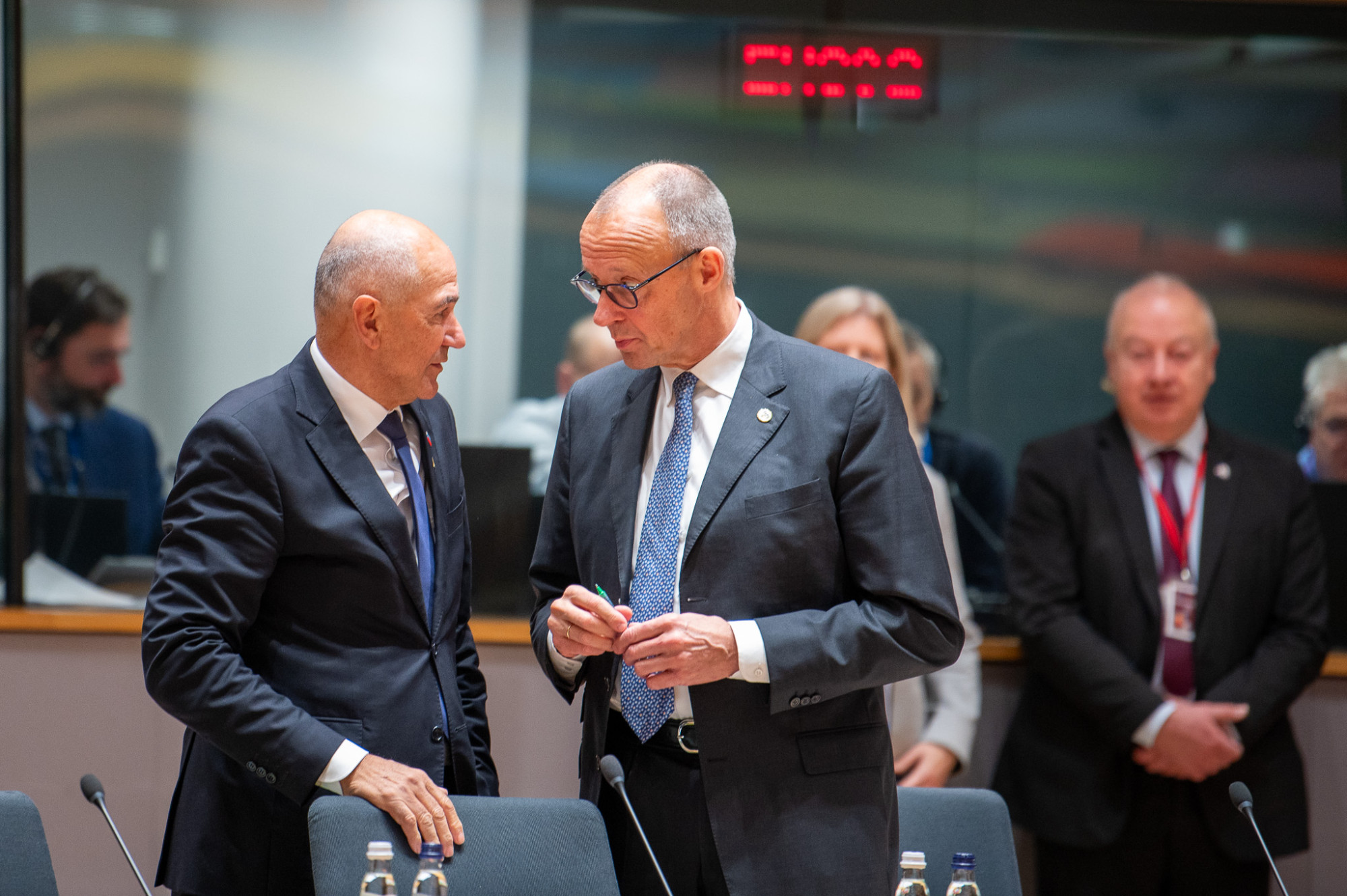
Prime Minister at the European Council | Author Office of the Prime Minister
In a statement before the start of the meeting, the Prime Minister shared his thoughts on the latest negotiating proposal from the President of the European Council. From the perspective of Slovenia's national budget, he considered the proposal to be relatively favourable. However, important issues remained, particularly with regard to cohesion and common agricultural policy funds, own financing sources, and defence spending.
The EU's next multiannual financial framework
The Prime Minister emphasised the importance of maintaining funding for cohesion policy and the Common Agricultural Policy.
"Ultimately, it always comes down to compromise: everyone gives a little, and you arrive at a figure. But the question is where there is room for compromise on cohesion and the Common Agricultural Policy, because these are two mechanisms that Europe genuinely needs," he said.
He considered the proposed cuts to the cohesion and common agricultural policies to be unreasonable, while expenditure on European administration was set to increase. He emphasised that this approach was inconsistent with the European Union's efforts to reduce bureaucracy and administrative burdens. In his view, reaching a compromise would require reducing the planned administrative expenditure.
He welcomed the decision to maintain funding for pre-accession assistance, given that enlargement remains one of the EU's key priorities. However, he cautioned that the proportion allocated to defence was insufficient in light of the current security situation.
Regarding new own resources for the EU budget, the Prime Minister highlighted Slovenia's support for introducing a digital tax. Slovenia also favours introducing an appropriate correction mechanism for the proposed new own resource based on waste electrical and electronic equipment. However, he opposes the proposed reduction in the share of collected customs duties that Member States can keep to cover their collection costs.
The Prime Minister expects intense negotiations and efforts to bring Member States' positions closer together. He also anticipates that the debate on the next EU budget will continue at the European Council meeting in December.
Economic growth as the path to achieving sustainable public finances and greater prosperity
The Prime Minister also responded to the European Commission's findings in the context of the European Semester. He assessed they were more encouraging for Slovenia than for most other EU Member States, especially in view of the high economic growth and the current budget situation. He noted that several other Member States had also received warnings about the possibility of excessive deficits, and that many are already subject to excessive deficit procedures.
He highlighted the consequences of the public sector wage reform adopted by the previous Government as one of Slovenia's key fiscal challenges, stating that this would increase the cost of running the state by EUR 2 billion.
He stressed that the Government would address this challenge adequately by boosting economic growth rather than imposing an additional tax burden on businesses and households.
"Our answer is that we are trying to boost economic growth, which means that we will generate more revenue and be able to finance greater needs through lower taxes," said the Prime Minister.
Turning to the upcoming referendum on the Development Act, he said it was not a vote of confidence in the Government. Rather, it is a decision on who will control a larger share of the money generated, the state or citizens and businesses.
"It's simply a question of whether the Government will have more money to allocate, or whether businesses will have more money to invest and create better jobs. It is also a question of whether people will have more money left in their pockets," he said.
He added that boosting economic growth and creating higher-value, better-paid jobs is also the foundation for long-term funding of the welfare state.
"This will not be a referendum on the Government. It will be a referendum on your pockets," the Prime Minister stressed.
Supporting Ukraine is an investment in our own security
The Prime Minister stressed that Slovenia supports securing a stable source of funding for Ukraine for at least the next two years, as it is crucial that Ukraine negotiates from a position of strength. He called on Member States to share the financial burden jointly. He suggested that splitting the funds into military and civilian assistance could make a compromise easier to reach.
"Investing in aid to Ukraine is also an investment in our own security," the Prime Minister said. He added: "If Ukraine has to negotiate for peace and a ceasefire while growing weaker by the day, we will be waiting a long time for peace."