

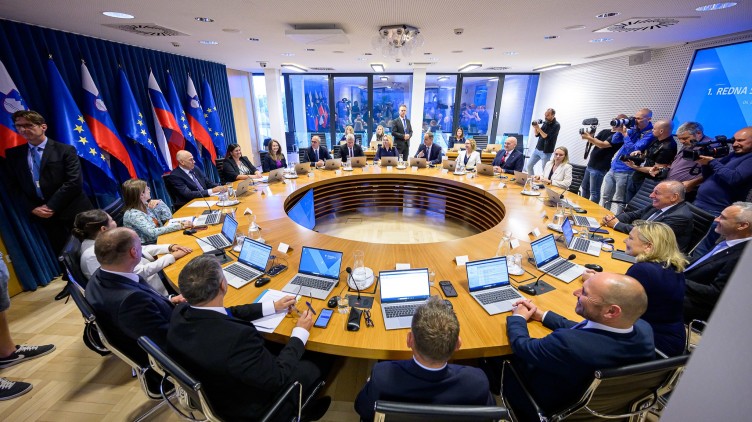
17th regular session of the Government of the Republic of Slovenia
The Government determined the text of the Proposal for the Act Implementing the Pact on Migration and Asylum. The key solutions proposed by the Act include the designation of competent authorities and rules for conducting procedures laid down by the Pact, mandatory screening of third-country nationals upon arrival at the EU’s external borders, the border procedure and border return procedure, the reception of applicants for international protection, safeguards for applicants for international protection, strengthened protection of vulnerable persons and procedural guarantees, the integration of beneficiaries of international protection, restrictions on freedom of movement and alternatives to detention, resettlement, determination of the Member State responsible for examining an application for international protection, the solidarity mechanism, procedures in crisis situations and cases of force majeure, and the Eurodac system and record keeping.
The Proposal for the Act Amending the Temporary Protection of Displaced Persons Act reduces administrative burdens and ensures greater systemic consistency by aligning the conditions for assistance with those applicable to citizens of the Republic of Slovenia and/or beneficiaries of international protection. At the same time, it strengthens the protection of the most vulnerable groups by allowing accommodation for unaccompanied minors to be extended until the age of 21 and by maintaining the basic level of financial assistance for private accommodation and pocket money for the most vulnerable groups of persons, including older people, persons unable to work and persons with disabilities. The amendment also seeks to prevent secondary movements of beneficiaries of temporary protection by taking into account, when granting assistance, the period during which temporary protection was recognised in another EU Member State. At the same time, it continues to ensure an adequate level of assistance and support for persons granted temporary protection for the first time in Slovenia.
The Government adopted the Proposal for the Act Amending the Foreigners Act. The rules governing family reunification for third-country nationals are being amended. A three-year period of lawful residence of a foreign national in the Republic of Slovenia is being introduced before the right to family reunification may be exercised, extending the required period of residence from one year to three years. The requirement of three years of lawful residence for entitlement to family reunification is also being introduced for persons granted subsidiary protection in the Republic of Slovenia, with the exception of unaccompanied minors. The general requirement concerning sufficient means of subsistence for the issuance of a residence permit to a third-country national and a registration certificate to an EU citizen is being increased from the basic amount of minimum income, which has stood at EUR 507.43 since 1 April 2026, to twice the basic amount of minimum income, i.e. EUR 1,014.86. The required amount of sufficient means for family reunification is also being increased. These means will continue to be determined in accordance with the criteria (weightings) used to determine the amount of minimum income under the legislation governing social assistance benefits. However, the value of the basic criterion (weighting) of 1 will no longer be based on the basic amount of minimum income, but on twice the basic amount of minimum income. The proposal also regulates the issuance of permanent residence permits to persons who, pursuant to the Act Regulating Relations between the Republic of Slovenia and Slovenians Abroad, have received a final decision recognising their status as a repatriated person or their right to repatriation. The required level of knowledge of the Slovenian language is also being raised. For foreign nationals who are not EU citizens, Slovenian language learning and Slovenian society orientation programmes will be co-financed at 60% of the programme price and will no longer be free of charge.
The Proposal for the Act Amending the Administrative Fees Act, through exemptions from or reductions in administrative fees, encourages liable persons to use a secure electronic mailbox, while at the same time reducing the state’s costs of postal service of documents.
The Government also approved the Act Amending the Matura Examination Act. The aim of the Act is to ensure a stable, professionally grounded and sustainable long-term framework for the vocational matura examination, in line with the objectives of secondary technical and vocational-technical education. The four-subject vocational matura is therefore being reintroduced, preserving a proven model for completing education while avoiding additional organisational, staffing and financial burdens.
In the area of healthcare, the Government considered and adopted the proposals for the Act on the Provision of Financial Resources for Investments in Slovenia’s Healthcare System and the Act Amending the Public Healthcare Institution Investments Act. The proposal for the first Act, which replaces the existing Act on the Provision of Funds for Priority Healthcare Investments for the 2021–2031 period, provides funding for priority healthcare investments in the 2026–2036 period, with a total of EUR 1.873 billion envisaged. The funds will be used for the construction and renovation of hospitals, community health centres and other healthcare facilities, the purchase of modern medical equipment, improvements to conditions for the education and training of healthcare professionals, and investments in the digitalisation of the healthcare system. The proposal for the Act Amending the Public Healthcare Institution Investments Act regulates the transfer of unused budget funds earmarked for investments in public healthcare institutions to a budgetary fund managed by the Ministry of Health.
The Government issued the Decree on the Establishment, Tasks and Organisation of the Government Office of the Republic of Slovenia for Decentralisation and Debureaucratisation, which will be published in the Official Gazette of the Republic of Slovenia. The Office is an autonomous government office carrying out analytical, organisational and legal tasks in support of the decentralisation and debureaucratisation of the state system.
The Government appointed Iris Kociper Haas Acting Chief of Protocol of the Republic of Slovenia. Iris Kociper Haas is an expert with more than 30 years of experience in organisational management, service development and the organisation of complex events. She previously served as Director and Deputy Director of JGZ Brdo – Protocol Services of the Republic of Slovenia. During Slovenia’s Presidency of the Council of the European Union in 2021, she was directly responsible for organising and coordinating catering, accommodation and related services for Presidency events and also participated in protocol coordination. Her experience includes team management, infrastructure projects and work in an international environment.