The Results of the First Democratic Elections in Slovenia
Ljubljana, April 16, April 25, May 23, 1990
Original, print, paper, 41 pages
Reference code: SI AS 142, Republiška volilna komisija, 5/II/B/1, 17/II/D/1, 25/II/E/1, 1/I/A/13
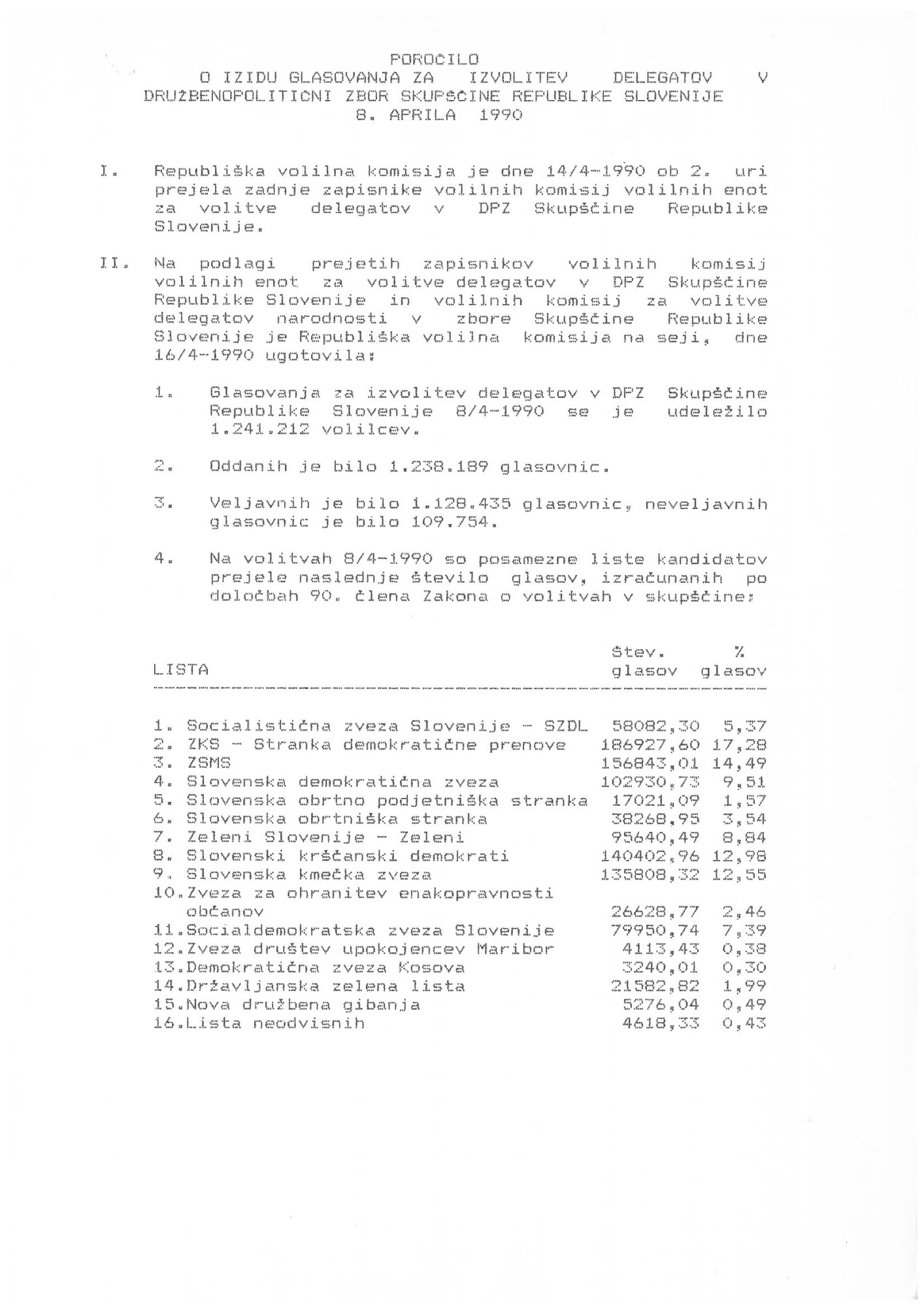
Report on the elections of delegates to the Sociopolitical Chamber of the Assembly of the Republic of Slovenia, April 8, 1990, April 16, 1990. | Author Arhiv Republike Slovenije
We are All Winners
The 11th parliamentary elections in the independent state of Slovenia are now behind us. The next step, in accordance with the electoral timetable, is for the State Election Commission to present the final voting results and draw up the official record of the elections, which is to be completed between March 31 and April 7, 2026. Considering the current political developments, it seems appropriate to use this month's archivalia to look back and recall the first post-war multi-party democratic elections in Slovenia. Held between April 8 and 22, 1990, these elections played a pivotal role in Slovenia's path to independence.
Today, documents and materials related to this historical event are preserved by the Archives of the Republic of Slovenia in the archival fonds of the Republic Election Commission (SI AS 142). They attract growing public interest on each anniversary of the event, particularly with regard to which candidates and political parties voters trusted most during this pivotal period in Slovenian history.
»People Got the Power« resonated throughout the Slovenian media following the first democratic elections. Journalist Tanja Starič wrote in the major newspaper Delo that »the phenomena of this first elections is that everyone felt like a winner – and, in a way, they were, because the winner of the elections was democracy, something Slovenian society at the time had never experienced before.«
Using the so-called combined electoral system, voters elected 240 delegates to the three chambers of the then Assembly: the Sociopolitical Chamber, the Chamber of Municipalities, and the Chamber of Associated Labour. A proportional electoral system was used for elections to the Sociopolitical Chamber (meaning that each party received a number of seats proportional to its share of the votes). A simple single-round plurality system was used for elections to the Chamber of Municipalities (the winner being the candidate who received the most votes), and a two-round plurality system was used for elections to the Chamber of Associated Labour (the winner being the party or the candidate that secured more than half of the votes cast).
April 1990 was election month. On April 8, voters elected representatives to the Sociopolitical Chamber and the Chamber of Municipalities. At the same time, they also elected four members of the Presidency, as well as the President of the Presidency of the Republic of Slovenia. On April 12, elections for delegates to the Chamber of Associated Labour were held, followed on April 22 by elections for delegates to local community councils, municipal sociopolitical chambers, as well as the second round of elections for delegates to the Chamber of Municipalities, and the second round of elections for the President of the Presidency. Voters for the delegates to the Sociopolitical Chamber had their work cut out for them, as more than 900 candidates competed for just 80 delegate seats. In practice, this meant that voters in each electoral district could choose from 15 or 16 political parties and more than 95 individual candidates on their lists.
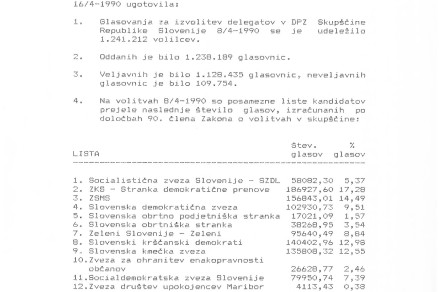
Based on the minutes received from electoral commissions of the electoral districts for the elections to the Sociopolitical Chamber of the Assembly of the Republic of Slovenia, as well as from commissions overseeing the elections of representatives of national communities to the chambers of the Assembly, the Republic Electoral Commission, at its session on April 16, 1990, determined the following: a total of 1,241,212 voters participated in the elections of delegates to the Sociopolitical Chamber on April 8, 1990. A total of 1,238,189 ballots were cast, of which 1,128,435 were valid and 109,754 invalid. As expected, voter turnout was high, with approximately three quarters of eligible voters casting their votes (76.2%). Individual candidate lists received the following number of votes:
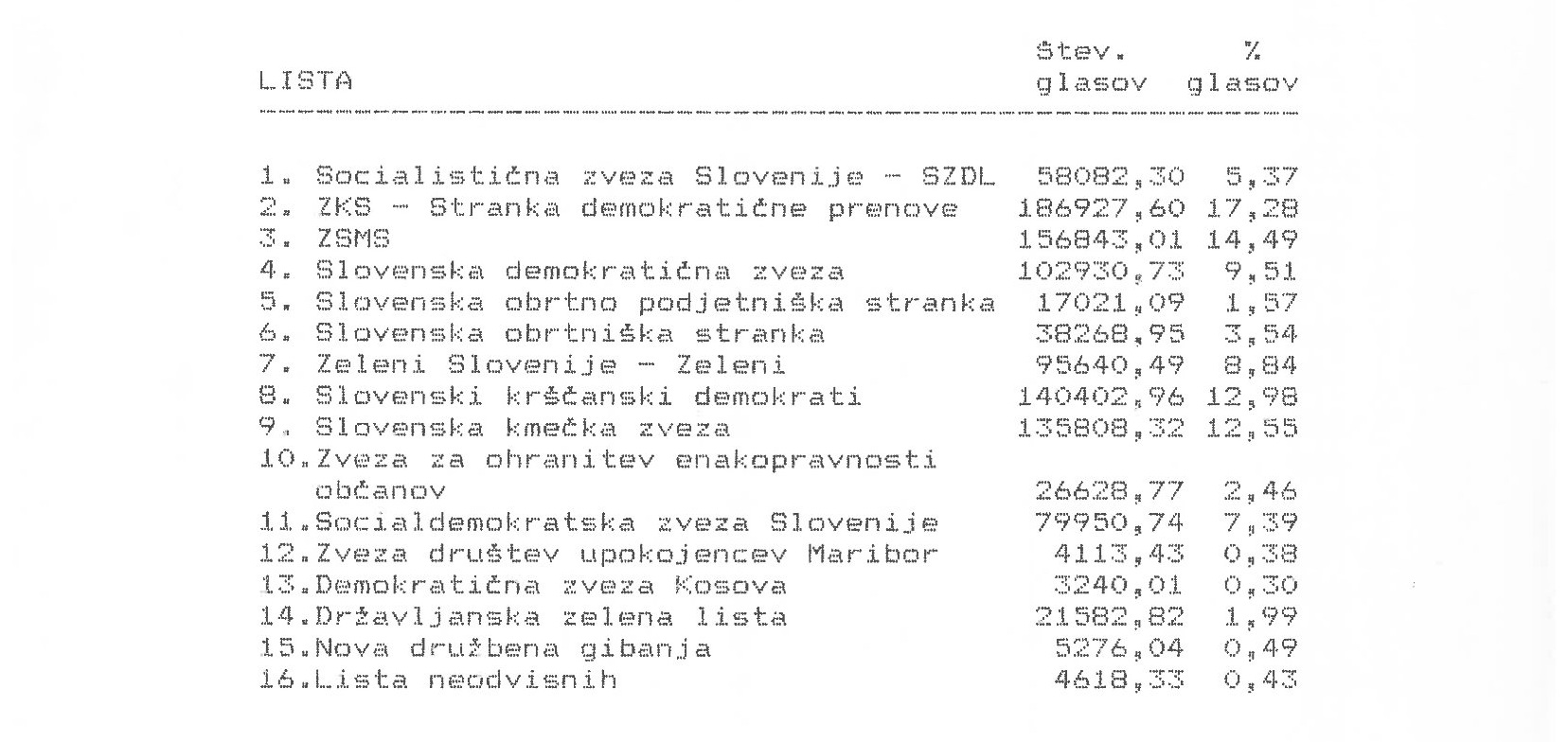
Excerpt from the report on the results of the vote for the election of delegates to the Socio-Political Chamber of the Assembly of the Republic of Slovenia on 8 April 1990. | Author Arhiv Republike Slovenije
The Commission's report includes the list of all elected candidates by individual electoral districts.
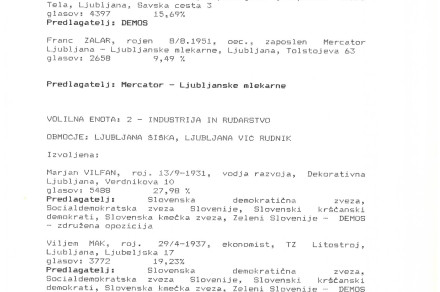
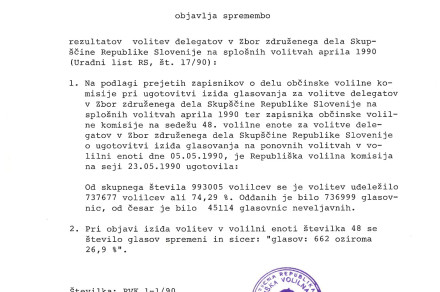
The elections of delegates to the Chamber of Associated Labour was held on April 12, 1990, except in those electoral districts where voters elected delegates, who alongside their primary work in the fields of agriculture and forestry, were also involved in related secondary activities; in these districts, the elections took place on April 8 and April 22 (in the municipalities of Škofja Loka and Jesenice). Of the total 993,005 eligible voters, 737,677 (74.29%) participated in the elections. 736,999 ballots were cast, of which 45,114 were invalid. The report includes the list of elected delegates by individual fields of work across 59 electoral districts.
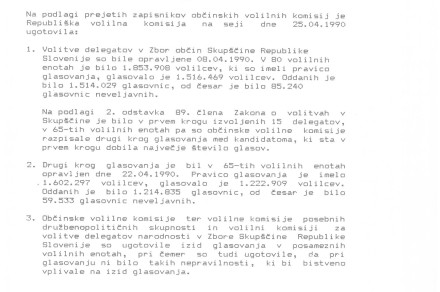
At its session on April 25, 1990, the Republic Electoral Commission announced the results of the elections of delegates to the Chamber of Municipalities. In the first round, held on April 8, 1,516,469 voters participated across 80 electoral districts. A total of 1,514,029 ballots were cast, of which 85,240 were invalid. Fifteen delegates were elected in the first round. In the second round, held on April 22, a total of 1,222,909 voters participated. 1,214,835 ballots were cast, of which 59,533 were invalid. The report includes the complete list of elected delegates to the Chamber of Municipalities for all 80 electoral districts.
The winners of the first secret, democratic and free Slovenian elections were, first and foremost, the voters, whose participation at the elections and their votes demonstrated their trust in a better vision of Slovenia’s development and a better life. The winners were also all the candidates, who had the courage to take on responsibility, if they received enough votes, during this difficult time of their country’s transition, when the old order was collapsing, and Slovenia’s future still seemed very uncertain. At the heart of it all was the spirit of the awakening national community, which united people across diverse ideologies and proved victorious in the months that followed. These democratic elections were just the beginning of the process that culminated on June 25, 1991, when Slovenia’s independence was proclaimed at Republic Square in Ljubljana.
Such victorious spirit of community remains part of our collective past, and we can only hope that it will be the winner in every future election.
Alenka Starman Alič
- SI AS 142, Republiška volilna komisija, t. e. 1, p. e. I/A/13, t. e. 5, p. e. II/B/1, t. e. 17, p. e. II/D/1, t. e. 25, p. e. II/E/1.
- Potočnik, Dragan: Prve večstrankarske volitve na Slovenskem. In: Studia Historica Slovenica, vol. 7 (2007), no. 1−2, pp. 103–131.
- Starič, Tanja: Prve demokratične volitve v Sloveniji. Delo, 7.4.2010 (retrieved 18.3.2026).
- Svenšek, Ana: Prve demokratične in najobsežnejše volitve v 30 letih parlamentarizma - RTV SLO, 8.4.2020. (retrieved 20.3.2026).
- Rokovnik_volilnih_opravil_VDZ_2026.pdf (številka: 041-5/2025-2). Državna volilna komisija, 6.1.2026 (retrieved 13.3.2026).