

Prime Minister Golob: Competitiveness is built through national development incentives
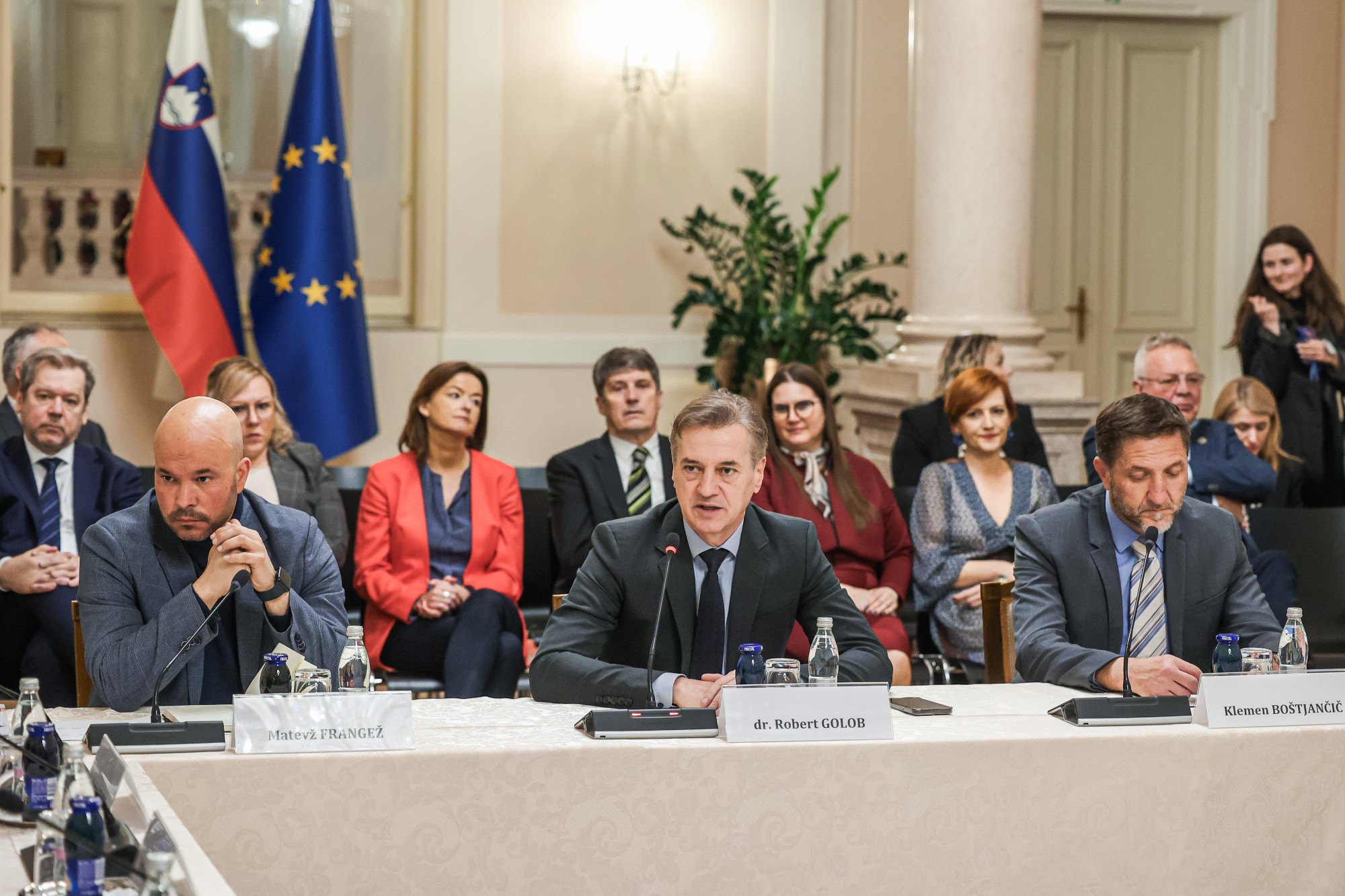
Prime Minister Robert Golob hosted representatives of the Slovenian business community at a special event. | Author Daniel Novakovič, STA
Together with the Minister of Finance, Klemen Boštjančič, Matevž Frangež, State Secretary at the Ministry of the Economy, Tourism and Sport, and Igor Mally, State Secretary for European Affairs in the Office of the Prime Minister, they discussed the future of Slovenia’s development model, the competitiveness of the economy, and key measures to increase value added and ensure stable economic development. Ministers from the governing coalition were also in attendance.
At a time of uncertain global conditions marked by geopolitical tensions and fluctuations in energy prices, the Prime Minister emphasised that Slovenia must maintain a clear development direction: stable energy markets, support for entrepreneurship, and targeted relief for the most productive segments of the economy. The Government has therefore already adopted initial measures to mitigate the impact of rising energy prices and has established crisis mechanisms to ensure a stable energy supply, which is also of key importance for Slovenian companies.
In his opening remarks, the Prime Minister said that the purpose of the meeting was to exchange views and reach a shared understanding of where more could be done together to improve the system. He noted that two rounds of coordination had taken place over the past six months. At the European level, a substantive discussion is under way on the measures Europe should adopt in order to preserve its global competitiveness. This will also be discussed by leaders at the summit in Brussels next week. At the national level, discussions took place in the context of the Government’s regional visits, during which government representatives have met with representatives of Slovenian businesses across different regions in recent months.
The discussion focused on opportunities for improvement and on an open and frank exchange with representatives of the business community.
Andraž Krajnc, Director of Caretronic d.o.o., a company specialising in healthcare and nursing technology and the digitalisation of healthcare, proposed measures to reduce administrative burdens and, as a representative of an export-oriented company, emphasised the importance of state incentives for export-oriented businesses.
Andraž Rumpret, Director of Iskra PIO d.o.o., a company active in pharmaceutical equipment and biotechnology, highlighted the importance of constructing the Third Development Axis, which would make the daily commute easier for the company’s employees. He also expressed support for reducing the tax burden on employees’ wages and stressed the importance of incentives for employment and for integrating young people into the labour market.
Marino Furlan, President of Intra lighting d.o.o., a manufacturer of lighting solutions, highlighted the importance of establishing favourable conditions for retired people who wish to continue working after retirement and outlined several proposals for employee incentive schemes.
Maks Prokop, Global Director for Legal and Compliance and Executive Member of the Management Board of Iskraemeco, a manufacturer of electricity meters and devices for energy measurement and management, underlined the importance of reducing the tax burden on wages and investing in infrastructure, particularly in improving air connectivity with major international hubs.
Sabina Sobočan, Director of Varis Lendava, a manufacturer of prefabricated bathrooms, emphasised the importance of addressing absenteeism and strengthening oversight of sick leave. She also highlighted the importance of taxing vacant apartments, which could help ease the tax burden on employees’ wages.
Nik Prebil, Director of the Slovenia Biotech Hills, an institute promoting the development of biotechnology and the pharmaceutical sector in Slovenia, proposed incentives to attract skilled professionals and emphasised the importance of cooperation with research institutions and the state. He also proposed simplifying procedures and introducing measures to attract foreign capital.
Gracijan Necmeskal, Director of Tpgagency, a company specialising in logistics, noted that the current challenges in maritime logistics are digitalisation, the green transition and labour shortages. He proposed incentives for education and training for young people in the field of logistics, praised the construction of the second track, and emphasised the importance of retaining the workforce in Slovenia.
Radovan Bolko, Member of the Supervisory Board of Kolektor Group d.o.o., highlighted value added as a key indicator of future development and the share of wages in value added, and welcomed the Government’s focus on increasing value added. He also emphasised the importance of investment and of appropriate incentives and support schemes for the economy.
Borut Čeh, Chief Executive Officer of Labena d.o.o., a company specialising in the development and testing of generic and biological medicines and gene therapies, emphasised the importance of reducing the tax burden on wages and praised the Government for its support for the gene therapy project.
Mark Pleško, Director of CosyLab d.d., a company developing control systems for large experimental physics facilities and radiotherapy, thanked the state for its support for projects and stressed that artificial intelligence should be introduced across all segments of society. He also proposed establishing an entrepreneurship council that would maintain a regular dialogue with the Government.
Tomaž Gornik, Director of Better d.o.o., a company specialising in healthcare informatics, said that Slovenia must create a more favourable environment for medium-sized enterprises and improve public procurement procedures. He also proposed using artificial intelligence to simplify procedures in public administration and thereby improve services for the public.
Joc Pečečnik, owner of the Elektronček Group d.o.o., welcomed the meeting between government representatives and business leaders. He proposed reforming the wage system and improving the position of sole traders, and also drew attention to the issue of absenteeism. He stressed that the state must invest in the digitalisation of public administration and expressed support for the taxation of properties that are not used as primary residences.
Matevž Frangež, State Secretary at the Ministry of the Economy, Tourism and Sport, welcomed the proposals put forward by representatives of the business community. He noted opportunities in digitalisation, innovative public procurement, recruitment procedures, siting and permitting procedures, construction permits and similar areas. "I believe that Slovenian businesses are currently faced with two main challenges: energy costs on the one hand and their ability to reward employees on the other. When it comes to rewarding employees, I would highlight the law on employee profit-sharing," said State Secretary Frangež. "The priority of this Government is to build a strong support ecosystem," he added.
Igor Papič focused on artificial intelligence, where the national platform is becoming increasingly clear. The minister highlighted the need to raise awareness of the risks associated with the use of free artificial intelligence tools, while also presenting opportunities for their use in the economy and in science. He reiterated that Slovenia is already implementing the project of an artificial intelligence factory and a supercomputer and is also planning a system to ensure the safe use of artificial intelligence for all citizens. Digitalisation is the key to modernising public administration.
Klemen Boštjančič, Minister of Finance, summarised the proposals put forward by representatives of the business community and expressed support for reducing the tax burden on wages. He noted that a number of measures had already been taken to activate retired people in the labour market. He also expressed support for shorter administrative procedures, further digitalisation of the state, incentives for exports, stronger economic diplomacy and faster planning, siting and permitting procedures. He emphasised that measures to address absenteeism had already been adopted and that the first results are already becoming visible. The Minister also voiced support for more flexible labour legislation and the taxation of properties that do not serve their intended purpose, and expressed openness to the proposal that the Government prepare a concrete strategy for the economy in the future.
In his closing remarks, Prime Minister Robert Golob emphasised the importance of economic competitiveness. "Competitiveness is built on two pillars. When we have national development incentives – not only European ones – we can use them to accelerate processes within individual sectors," he said, citing the automotive industry and the GREMO project as a good example of cooperation, where entrepreneurs were also motivated by state development incentives. He expressed the wish to continue with this model and to introduce it in other sectors.
As the second pillar, the Prime Minister highlighted the need to reduce the tax burden on wages. "We agree that vacant apartments should be taxed and that the revenue generated in this way should be actively directed towards reducing the tax burden on the wages of development professionals and those jobs that create the highest value added. If we reduce the burden on such jobs, society will ultimately gain the most in return," he said.