

The Archives of the Republic of Slovenia decorated with the Golden Order for Merits
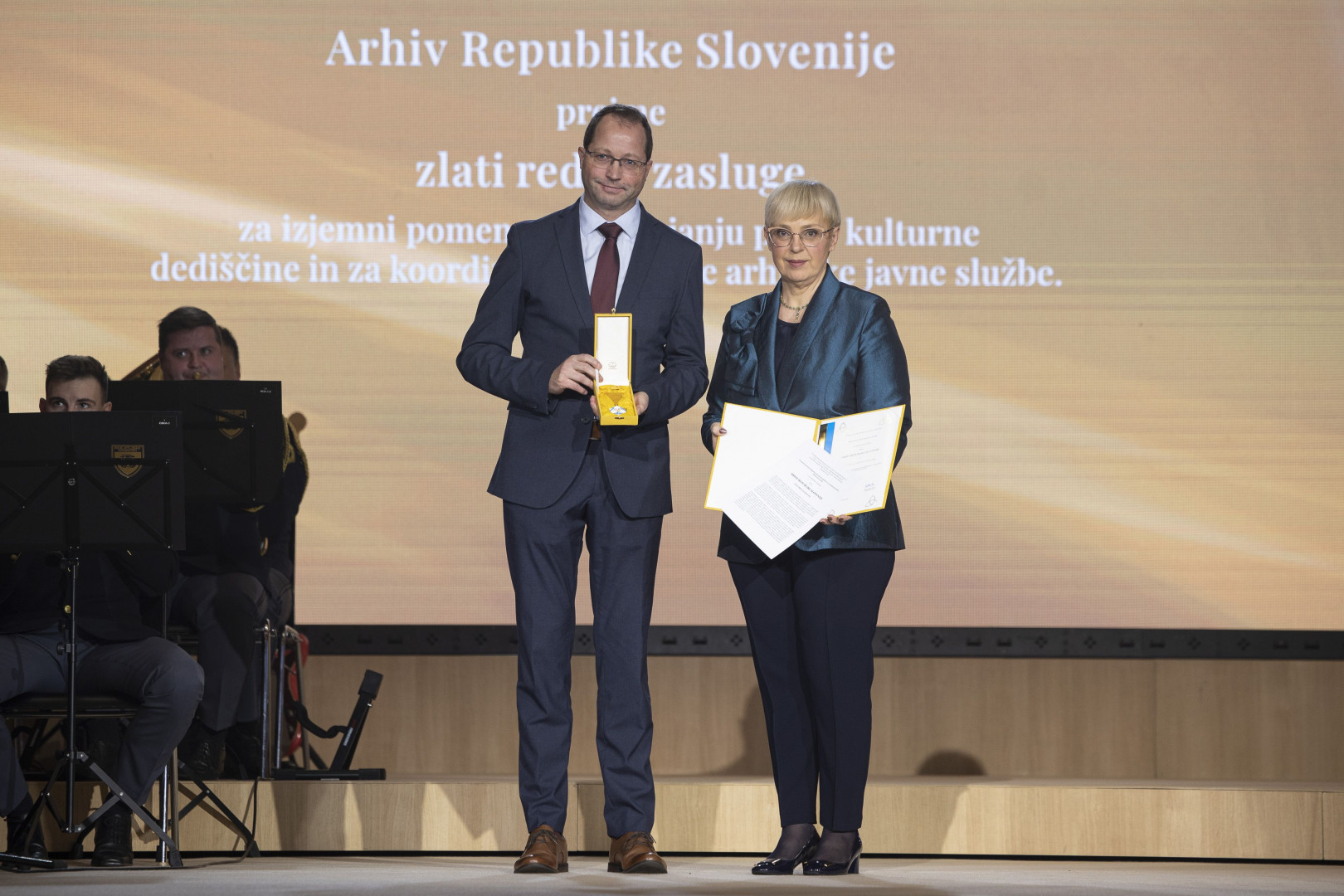
The Director of the Archives of the Republic of Slovenia, Dr. Andrej Nared, and the President of the Republic of Slovenia, Dr. Nataša Pirc Musar, at the presentation of the Golden Order for Merits. | Author Katja Kodba/STA
In many ways, this year has been a turning point for the Archives of the Republic of Slovenia. After decades of effort, we finally moved into our new premises on Poljanska cesta at the end of last year; this has allowed us to focus more calmly on our regular work this year, while also celebrating the 80th anniversary of the archives as an independent institution with great enthusiasm. We filled this jubilee year with numerous events and projects: we organized two exhibitions, several open-door days, an archival symposium, and a formal academy, as well as publishing an extensive commemorative volume. Unexpectedly, we saved the best for last—for today—as I accept this high state decoration on behalf of many generations of archivists of the Slovenian state archives as a symbolic recognition of our work.

The Golden Order for Merits. | Author Borut Jurca/Archives of the Republic of Slovenia
The Care of Archival Records in Slovenia has a long tradition, evolving since the mid-19th century in a manner similar to other lands of the Habsburg Empire. In Carniola, and after 1918 in the Yugoslav part of Slovenian territory, it was closely linked to the Provincial Museum of Carniola (founded in 1821) and subsequently the National Museum in Ljubljana. Following World War II, the Slovenian national archives emerged from this museum by taking over its archival funds and collections.
This was formalized by a decree of the National Government of Slovenia, adopted on October 31, 1945, which established the Central State Archives of Slovenia. Due to administrative and political changes, the institution was renamed several times. Its current name, the Archives of the Republic of Slovenia, dates back to 1990, when it symbolically became the central guardian of the archival material of the sovereign Slovenian state. Following political changes and democratization, "special archives" were gradually incorporated into the national archives: the Historical Archives of the Central Committee of the League of Communists of Slovenia (1990), the Archives of the Institute for the History of the Labour Movement (1992), and parts of the archives of the Ministry of the Interior, including the material of the former State Security Service (1998).
In the decade following independence, the work of the state archives was influenced not only by these mergers but particularly by the acquisition of archival material from abolished socio-political organizations and administrative bodies of the former socialist republic. During this time, the national archives proved to be a crucial source of information for the enforcement of citizens' rights. Through the provision of copies and certifications, it enabled documentation for denationalization claims, the rights of victims of wartime and postwar violence, the reopening of judicial processes, and the acquisition of citizenship. During this period, it became clear that archival material transcends the significance of national cultural heritage; it is also a vital, and often unique, source of data for the enforcement of individual and collective rights. Thus, the national archives became a cornerstone institution for ensuring the legal security of the state and its citizens.
The anniversary of the national archives coincides with the acquisition of new, modern premises. At the end of 2024, it moved into a fully renovated and partially extended former barracks, which has become the modern headquarters of the national archives. It houses precious archival material spanning from the Middle Ages to the present day, comprising 30,000 linear meters organized into nearly 2,000 archival funds and collections.
The national archives is the central state archival institution with the highest authority in the field of archival protection in Slovenia. As a body within the Ministry of Culture, it ensures the uniform professional execution of archival activities and collaborates successfully with regional archives in directing and coordinating the archival public service. The state archives serves as the seat for inter-archival working groups, professional advisory bodies, and commissions for professional examinations and titles.
As the custodian of archival material from its creation to its public use, the national archives supervises the handling of documentary material, issues professional instructions for appraisal, and trains staff at the creating entities. It protects the public archival material of state bodies, public funds, agencies, and other legal entities operating at the national level. Furthermore, it preserves private and film archives. To ensure a comprehensive overview, it maintains the national register of public archival material, records of Slovenian-related archives abroad, and the national register of public symbols, coats of arms, flags, and seals.
Through research, publishing, and international projects, the national archives strengthens the integration of Slovenian archival science into the international sphere. It has enjoyed decades of fruitful cooperation with cultural, heritage, and scientific research institutions in Slovenia and maintains exemplary ties with the national archives of many countries, particularly in Europe.
The protection of national cultural heritage is further enhanced by the Slovenian Film Archives and the Center for Conservation and Restoration. The former has preserved the majority of Slovenian film production from 120 years of creativity, while the latter serves as the central workshop ensuring the survival of endangered written and graphic heritage held by the central archives, other public and ecclesiastical archives, and various institutions.
The national archives is therefore not merely a paper repository, but a foundation of the rule of law, a guarantee of democratic transparency, and an irreplaceable guardian of state and national memory. It actively conveys this message to the public through exhibitions, pedagogical work with schools, and extensive publishing, having issued over 210 publications to date. Through its activities, the national archives popularizes history and strengthens the shared cultural heritage of the Slovenian space—the DNA of national identity and self-confidence—while consolidating the statehood of the Republic of Slovenia.
By awarding the Golden Order for Merits, the Republic of Slovenia expresses its gratitude to the Archives of the Republic of Slovenia for its significant contribution to the development of the archival profession, its exceptional importance in preserving written cultural heritage, and its coordination of the state archival public service.