

Council of Europe's Steering Committee on Democracy discusses the reform of the public sector employee and salary system
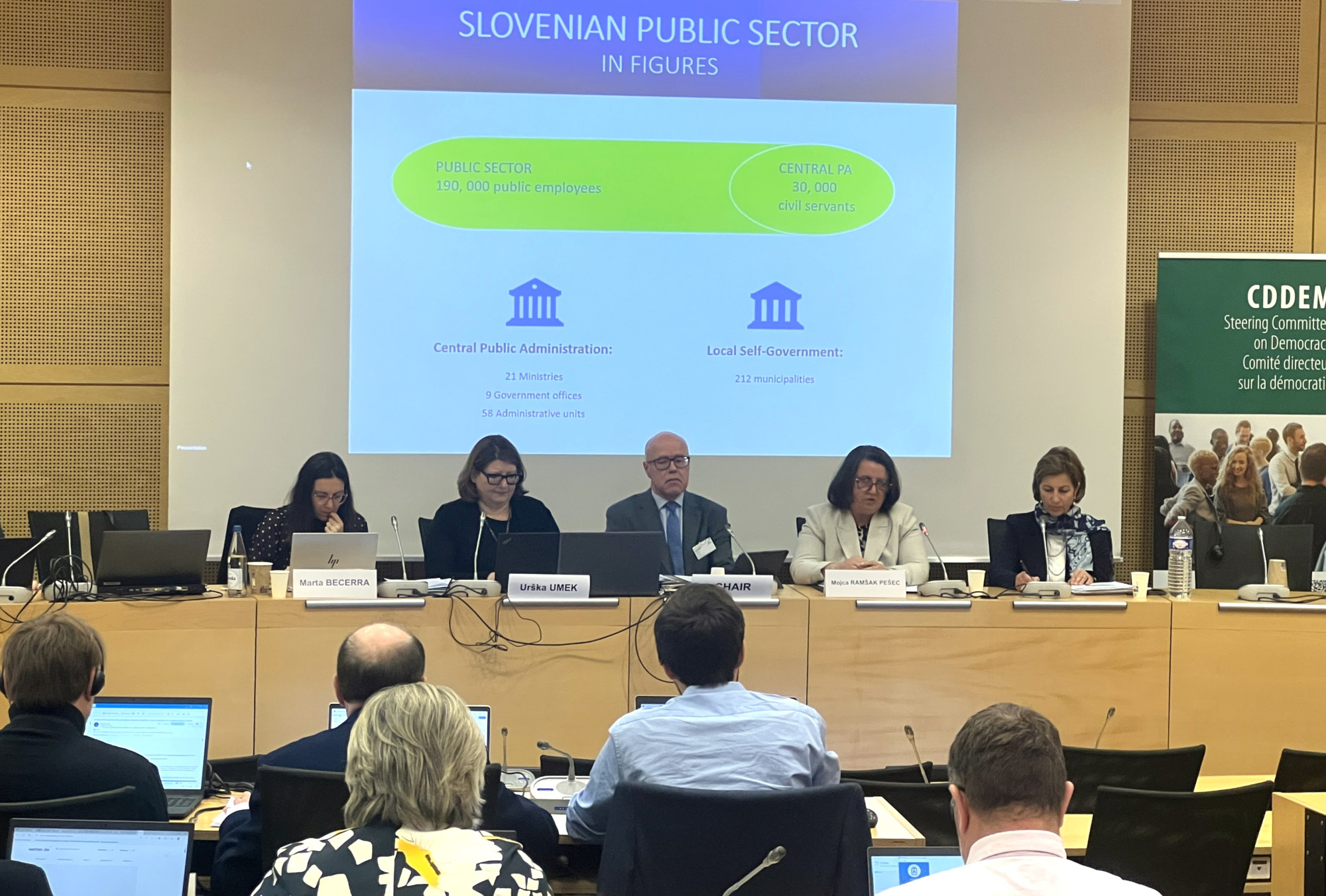
State Secretary of the Ministry of Public Administration Mojca Ramšak Pešec presented Slovenia's recent reforms to the public sector salary and employee systems as examples of best practice | Author Ministry of Public Administration
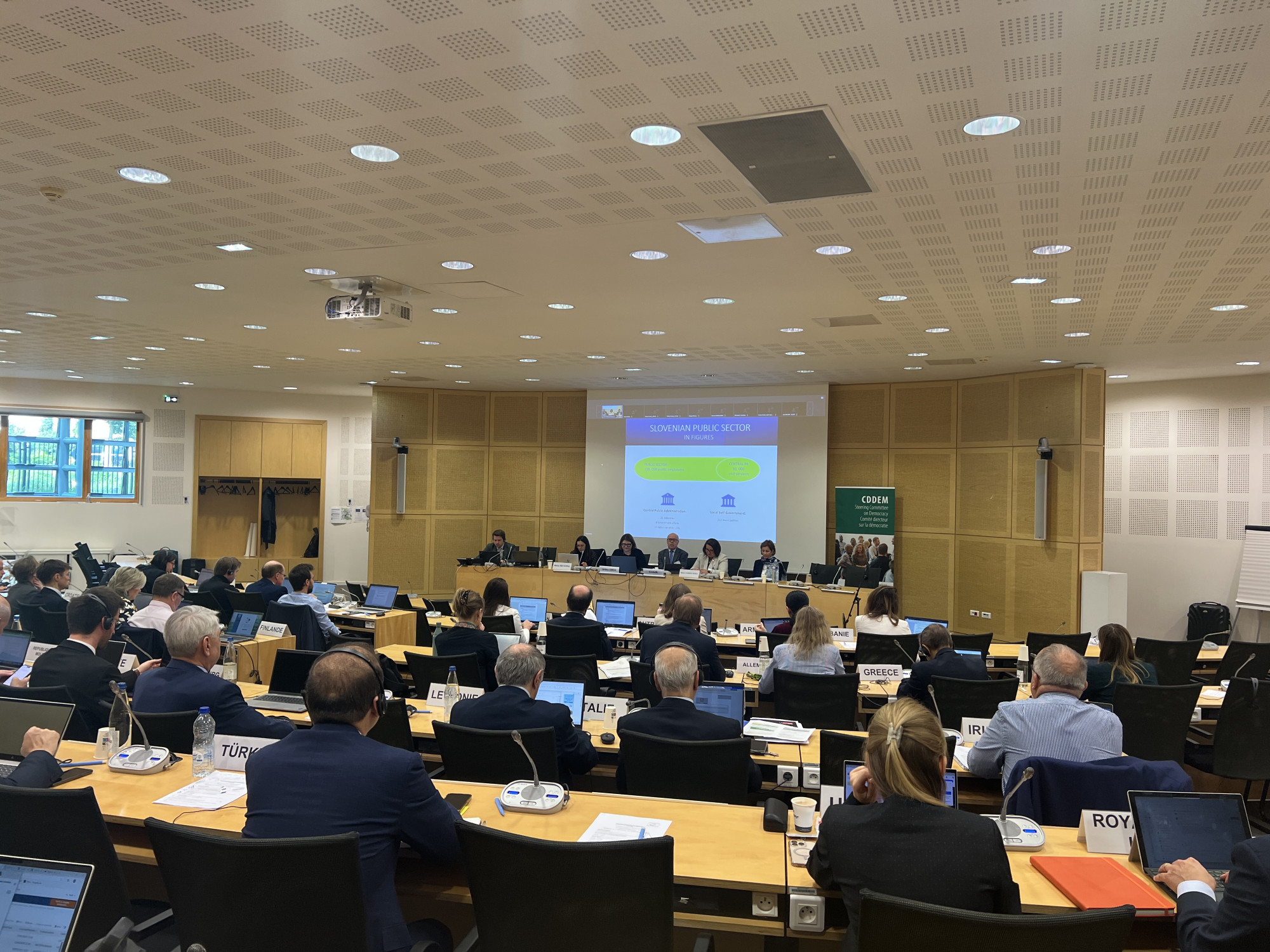
In her introduction, the State Secretary emphasised that labour changes in Slovenia are coordinated and adopted through social dialogue within the Economic and Social Council, covering both the private and public sector employees. "Social dialogue also has a long tradition in the public sector. All amendments to laws and other acts governing the status of public sector employees are harmonised through negotiations between the Government and representative public sector trade unions," noted Mojca Ramšak Pešec. She added that the recent public employee and salary system reforms had followed this same process. "Given that there are 48 different unions in the Slovenian public sector, negotiations lasted nearly two years, ultimately resulting in an agreement signed by 80% of the unions."
At the meeting, the State Secretary presented the broader framework of changes to human resources management within the narrower public administration and the wider public sectors in Slovenia. The aim of this comprehensive, multi-segment reform is to ensure that public employees are motivated and satisfied, and can therefore provide efficient, high-quality public services to all inhabitants. Looking ahead, the public sector will need to respond primarily to demographic shifts, digitalisation, and emerging professions, while also navigating the challenges of new forms of work and various crisis scenarios.
In agreement with the public sector's representative trade unions, and in accordance with the new Common Foundation of the Public Sector Salary System Act (ZSTSPIS), one aspect of these changes is the reform of the salary system that has already been implemented. The reform introduces a financially sustainable and stable system that takes into account differences between individual salary groups. The new salary system is an important step towards making the public sector competitive and attractive in the labour market once again, and towards achieving a fairer, more transparent and more efficient system.
The second part of the changes involves adopting the new Public Employees Act and introducing a reformed system for public sector employees. The key innovation of this system is the establishment of a Human Resources Centre with redesigned recruitment and selection procedures. These procedures will be fully digitalised to ensure uniform entry requirements and transparent selection procedures for candidates. "With the changes to the internal labour market, our aim is to encourage mobility among public sector employees and help them to broaden their knowledge. We have also extended this option to municipal administrations. If they join the internal labour market, they will be able to seek potential candidates among state administration employees," explained State Secretary Ramšak Pešec. The Centre will also be responsible for developing competencies and launching calls for HR scholarships.
These HRM goals are further detailed in the recently adopted Human Resources Management Strategy in State Administration until 2030, which carries the message-driven title "People are the key to better administration." The strategy is designed to establish strategic and comprehensive human resource management, utilise the potential of public employees effectively, and create an attractive work environment with a development-oriented organisational culture.
The Steering Committee on Democracy (CDDEM) is a Council of Europe intergovernmental working body that addresses democracy-related issues. Its remit includes electoral legislation, the structure of democratic institutions, local self-government, measures to promote democratic resilience and participatory democracy, as well as legislation, policies, and practical measures related to good democratic governance.
Bilateral meetings
During her visit to Strasbourg, yesterday afternoon, State Secretary Mojca Ramšak Pešec and her delegation met with representatives of the Permanent Representation of the Republic of Slovenia to the Council of Europe. Together with Berta Mrak, Ambassador to the Permanent Representation of the Republic of Slovenia to the Council of Europe in Strasbourg; Matjaž Gruden, Director of the Council of Europe's Directorate for Democracy; and Urška Umek, Secretary of the CDDEM Committee; they discussed the importance of democracy and human rights, democratic participation, the role of education, and the impact of modern technologies and artificial intelligence. They also discussed efforts related to the implemented salary reform. The State Secretary summarised the recent monitoring of the local self-government system and the Council of Europe's delegation visit in December 2024. She presented the findings of the OECD study, carried out by the Ministry last year, regarding the factors influencing trust in public institutions.
This afternoon, the State Secretary is also scheduled to meet with Mathieu Mori, Secretary General of the Congress of Local and Regional Authorities. Their discussion will focus on the recent monitoring of the local self-government system and the related Council of Europe's delegation visit to Slovenia last December, and the amendment to the Local Elections Act. They will also touch upon the upcoming local elections in 2026. On behalf of the Ministry, State Secretary Ramšak Pešec will invite Secretary General Mori to observe the elections.
Finally, the State Secretary will meet with Gianluca Esposito, the Council of Europe's Director General of Human Rights and Rule of Law, to discuss access to public information. Slovenia was one of the first countries to sign the Council of Europe Convention on Access to Official Documents (also known as the Tromsø Convention). This year also marks the 20th anniversary of the adoption of the first law to regulate this area. Access to public information is well regulated in Slovenia, and the country has consistently striven for transparency in the functioning of the public sector. This is also confirmed by the Council of Europe’s group of experts, who are conducting monitoring activities in Slovenia and have identified no deviations in preparation for their final report.