

Government established Strategic Council for AI and began preparing measures to address the general government deficit
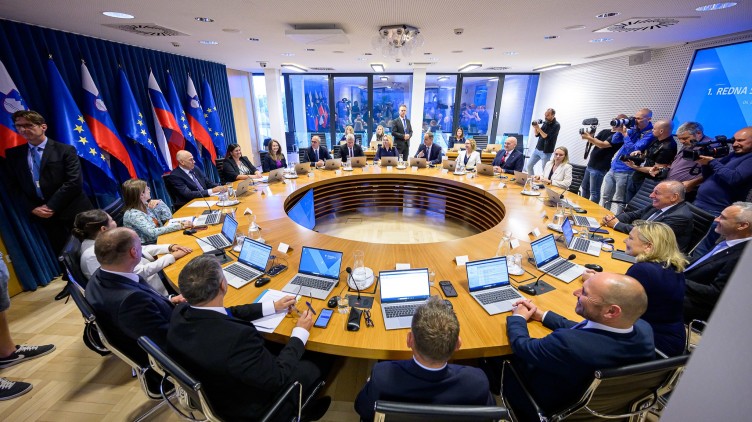
The Government established the Strategic Council for Artificial Intelligence and Digitalisation as an advisory body to the Prime Minister. The Council's task will be to accelerate the development and use of artificial intelligence and Slovenia's digital transformation. The aim is to position Slovenia among the five most digitally advanced European countries by 2031. The Strategic Council comprises 48 members. In the area of cyber resilience, the Government designated the competent authorities responsible for implementing the European Cyber Resilience Act and also took note of the planned signing of a Memorandum on Strategic Cooperation in the Field of Artificial Intelligence with the Ministry of Industry and Trade of the Czech Republic.
In its Position on the Assessment by the Fiscal Council of the Republic of Slovenia of the Budget Documents for 2027 and 2028, the Government explains that the preparation of measures to contain the general government deficit is already under way. During the preparation of the budgets, ministries, the Health Insurance Institute of Slovenia and the Pension and Disability Insurance Institute of Slovenia were called upon to prepare measures that would contribute to reducing the deficit, controlling expenditure growth, improving the efficiency of public spending and adjusting expenditure to actual needs. Some measures require legislative amendments, while others do not require changes to legislation but primarily involve optimising public sector operations and, for example, organising various registers of persons receiving certain payments from public funds in order to eliminate anomalies and duplication. It is essential that the measures be prepared in a timely manner, that they have a verifiable financial impact as early as 2027, and that their implementation can be monitored and supervised.
The Government approved the Proposal for an Act on the Accessibility and Use of Means of Payment, which regulates the constitutionally recognised right to use cash, introduces a free package of payment services for consumers who receive regular payments into a payment account, and at the same time requires providers of goods and services to accept at least one electronic means of payment in addition to cash. The immediate reason for preparing the proposed Act is the new provision of Article 74a of the Constitution of the Republic of Slovenia, which regulates the right to use cash. Without an implementing act, this constitutional right, which indirectly also encompasses the right of access to cash, could not be exercised.
Slovenia supports the continued implementation of the European Pillar of Social Rights Action Plan and the achievement of the EU's targets for 2030. It emphasises the importance of skills development and digital competences, reducing poverty and social exclusion, and ensuring equal opportunities. Slovenia also advocates greater consideration of demographic challenges, particularly low birth rates and population ageing, in the formulation of European and national policies.
Slovenia supports the proposed European framework for housing affordability that would enable Member States to take more effective action in areas facing the greatest pressures on the housing market, including by restricting short-term accommodation rentals. At the same time, it emphasises that housing policy must remain within the competence of Member States and local authorities, and that measures must be proportionate and adapted to local circumstances. To improve housing affordability, Slovenia highlights above all the need to increase housing supply.
Slovenia supports changes to the EU Emissions Trading System that would better align climate objectives with economic competitiveness. It advocates a slower reduction in the total number of emission allowances and the continuation of their free allocation after 2030, as well as greater predictability for investments in decarbonisation. It also supports strengthening the Innovation Fund and establishing the European Industrial Decarbonisation Bank.
The Government adopted the Decree on the Detailed Delimitation of the Burial Area for the Remains of Victims at Žale Cemetery in the Municipality of Ljubljana. The purpose of the Decree is to define the burial area in greater detail by specifying the land parcels. This provides a more precise spatial definition of the area designated for the burial of victims' remains as required by law.